Thursday, April 30, 2026

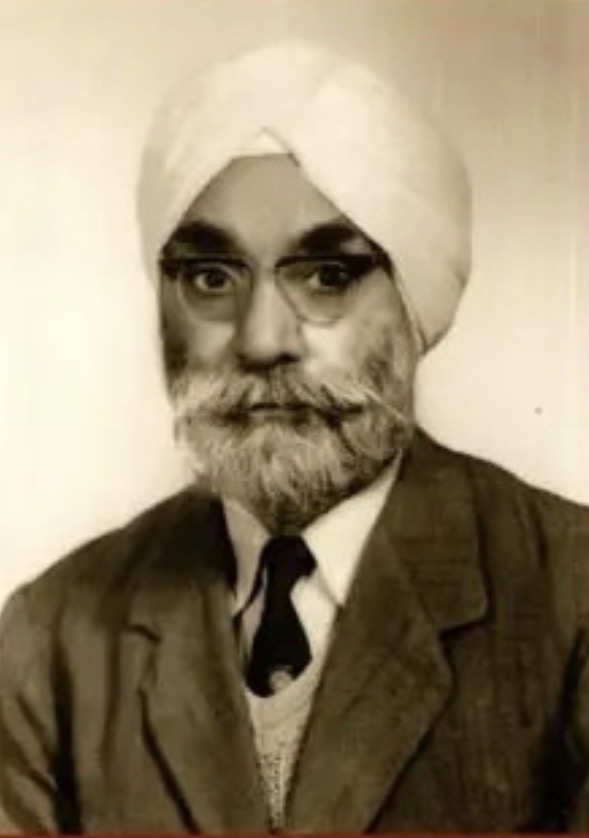
Prof Dr Ganda Singh - A pioneer of Sikh Historiography


Prof Dr Ganda Singh

Dr. Ganda Singh – A Scholar Who Preserved Our Roots

As I reflect on the lives of great scholars who have shaped our understanding of Sikh history, one name that stands tall with quiet dignity is that of Ganda Singh.

Born on 15th November 1900 in village Hariana, District Hoshiarpur, into a humble family, his journey was anything but ordinary, to Hukam Devi and Jawala Singh. He was married to Amar Kaur, also known as Inder Kaur. 

He received his primary education in his village and completed his matriculation from Government High School, Hoshiarpur in 1919. He briefly joined F.C. College, Lahore, but soon enlisted in the Indian Army, where he served in Rawalpindi, Peshawar, and Iraq. After leaving the army in 1921, he worked with the Anglo-Persian Oil Company in Abadan, Iran, from 1921 to 1930. During this period, he came under the influence of Sir Arnold Wilson, a distinguished scholar and the company’s manager, assisting him in preparing a bibliography of Iran. This scholarly exposure, along with his travels to Europe, nurtured his deep interest in historical research, he carried with him not just experience, but a mission.

Returning to India in 1930, he contributed to Giani Hira Singh’s journal Phulwari in Lahore. In 1931, he joined Khalsa College, Amritsar, as the head of the Sikh History Research Department, where he served with dedication for nearly two decades. During this time, he undertook extensive efforts to collect and preserve rare manuscripts and books from major centers such as Rampur, Bankipur, Patna, Kolkata, and Delhi, significantly enriching the institution’s library.
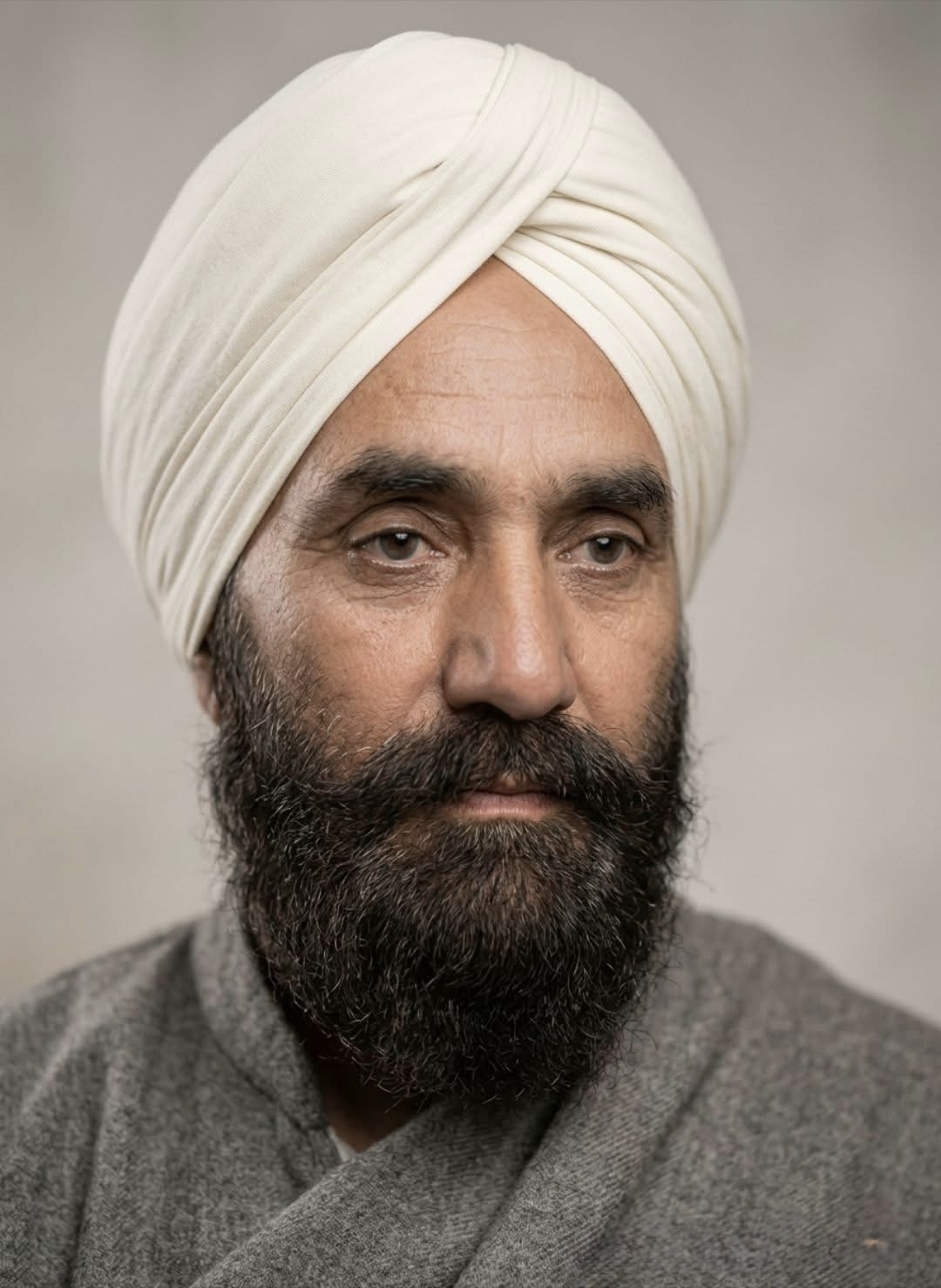
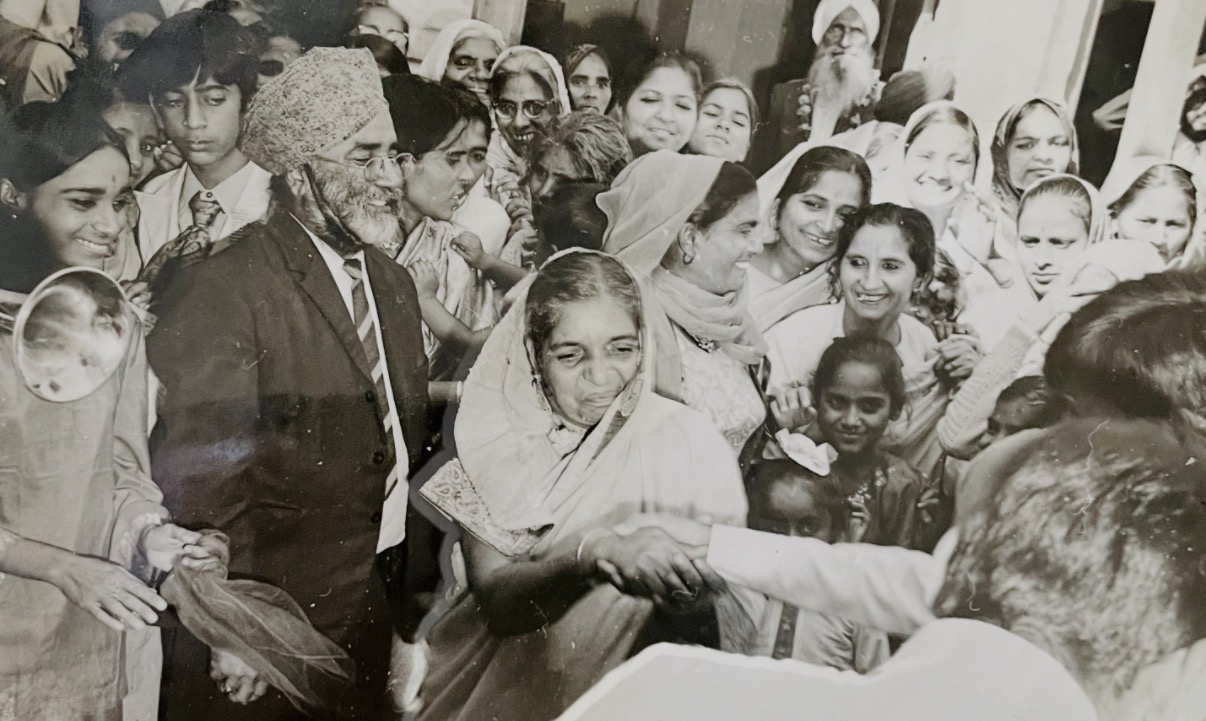
Dr Ganda Singh in his youth. Credit to Jasmeet Kaur!

At Khalsa College, Amritsar, he devoted nearly two decades to building a strong foundation for Sikh historical research. He travelled, collected, and preserved rare manuscripts from places like Rampur, Patna, Kolkata, and Delhi. I often feel that such silent and dedicated efforts are what truly safeguard our heritage.

Later, as Director of Archives in PEPSU and then as the founding head of Punjab Historical Studies at Punjabi University, Patiala, he created institutions and platforms that continue to guide scholars even today. His journal Punjab Past and Present and the Punjab History Conferences became milestones in academic excellence.

What stands out most is his deep knowledge of Persian. Through this, he brought forward authentic sources, corrected misconceptions, and presented Sikh history with clarity and integrity. His scholarship was not only intellectual—it was rooted in sincerity and the Khalsa spirit.

His courage was equally inspiring. Returning the Padma Bhushan in protest against Operation Blue Star showed that for him, principles came before recognition.

For me, however, his work takes on an even deeper meaning.

Being connected to the lineage and legacy of Bhai Nand Lal Goya, the poet laureate in the court of Guru Gobind Singh, I feel a personal sense of gratitude towards Dr. Ganda Singh. Bhai Nand Lal’s writings, originally in Persian, carry immense spiritual and literary depth, but for many of us, they would have remained distant without his efforts.

Dr. Ganda Singh became a bridge between generations.
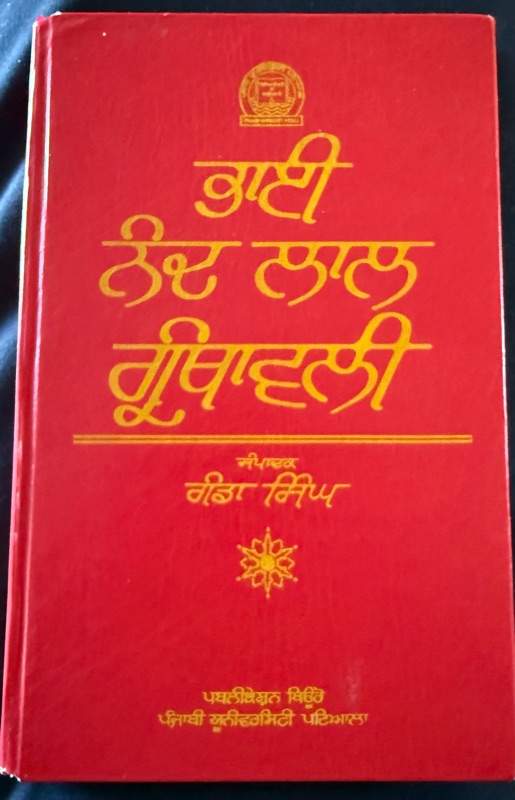

Bhai Nand Lal Granthavali published by Punjabi University in 1963


In 1949, he was appointed Director of the Archives Department of PEPSU, where he gathered invaluable records and documents from eight princely states. He earned his Ph.D. from Panjab University in 1952 with a thesis on Ahmad Shah Durrani. Later, he was honored with D.Litt (Honoris Causa) degrees by Aligarh Muslim University (1969) and Punjabi University, Patiala (1978).


In 1962, he became the founding head of the Department of Punjab Historical Studies at Punjabi University, Patiala. There, he initiated several research projects and edited the bi-annual journal Punjab Past and Present. He also established high standards for the annual Punjab History Conference, which became an important platform for scholarly exchange on Punjab historiography.


A scholar of Persian, Dr. Ganda Singh introduced numerous primary sources into Sikh historical research. His writings, rooted in the Khalsa spirit, are marked by objectivity and reliance on authentic evidence. He played a crucial role in dispelling misconceptions and presenting a balanced account of Sikh history.


He was honored by the Punjab Government (1963) and the SGPC, Amritsar (1964). In 1983, he was awarded the Padma Bhushan by the Government of India, which he later returned in protest against the Operation Blue Star.


Dr. Ganda Singh also made a monumental contribution to the study of Bhai Nand Lal Goya, the poet laureate in the court of Guru Gobind Singh. With his deep knowledge of Persian, he worked extensively on collecting, editing, and translating Bhai Nand Lal’s works. The Bhai Nand Lal Granthavali, published through Punjabi University, Patiala, stands as an encyclopedic compilation of these writings.


Recognizing the difficulty many readers faced with Persian, he undertook the significant task of rendering these works into Gurmukhi script, making them accessible to a wider Sikh audience. While those proficient in Persian can still appreciate the original literary beauty, his efforts ensured that the teachings and poetry reached the common reader in a more familiar and understandable form.


The initial efforts to compile Bhai Nand Lal’s works were inspired by Sant Sohan Singh of Malaysia and Sardar Joginder Singh (M.S.Ed.), who helped gather scattered manuscripts into a unified collection. Dr. Ganda Singh’s scholarly rigor and dedication gave this work enduring value, making it widely referenced and deeply respected in modern Sikh and Punjabi scholarship.

I often reflect that while those who know Persian can enjoy the original beauty, it is because of scholars like him that the essence has reached people like us in a language we live and breathe.
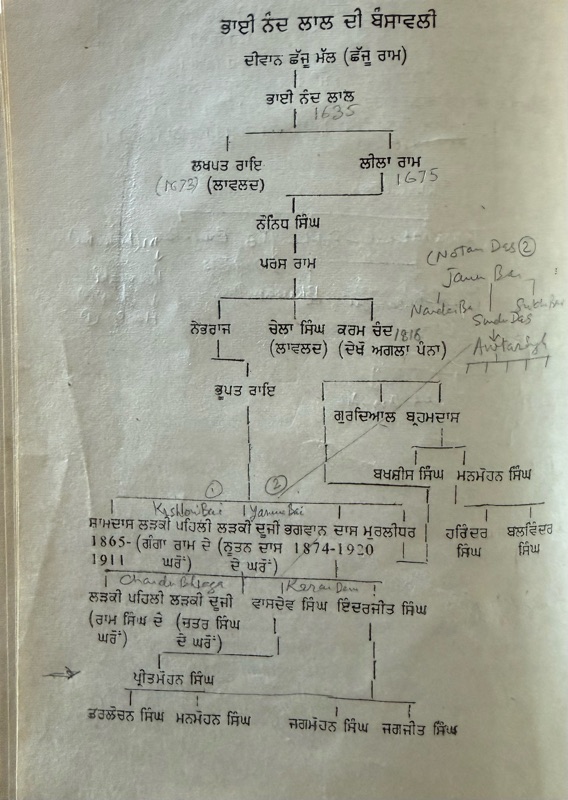
Mention of my name I the book elates me.

In a way, his work has also helped preserve a part of my own heritage. I feel truly elated that my own name finds a place in the family tree of Bhai Nand Lal as detailed in his scholarly works. For me, this is not a merely a mention, it’s a moment of deep connection with my roots, a quiet affirmation  of belonging to a legacy that has been preserved with such unmatched dedication. Dr Ganda Singh researched wrote a full paragraph on my immediate family
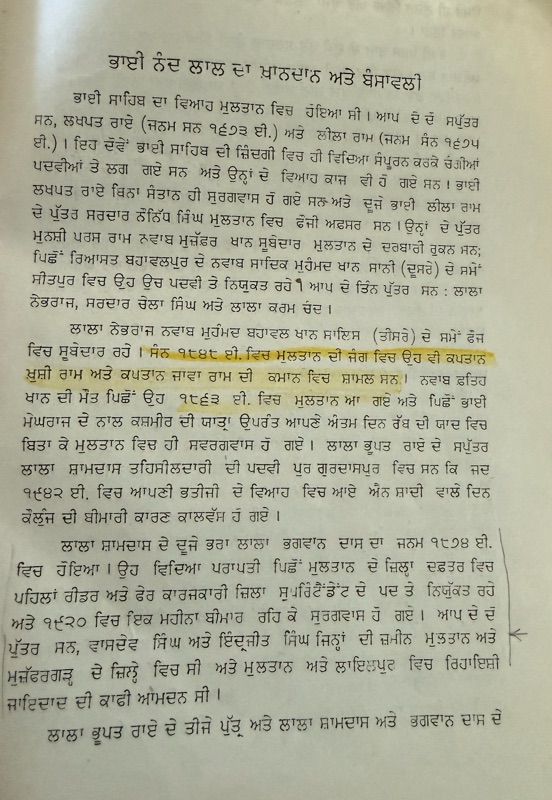
Here is details of full Paragraph on my Dada ji L Bhagwan Das, his elder brother L Sham Das and my father S Vasdev Singh Retd Acting Superintendent in District and Session courts in Karnal and my uncle S Inderjit Singh an advocate in Punjab and Haryana High Court Chandigarh

As I continue my own journey of documenting family history and writing about our roots, I draw inspiration from such towering personalities. They remind us that history is not just to be read, it is to be preserved, lived, and passed forward.

And through his work, he continues to guide us even today.

With humility and gratitude,

Saturday, April 25, 2026

Vasdev de Munda Di Kothi

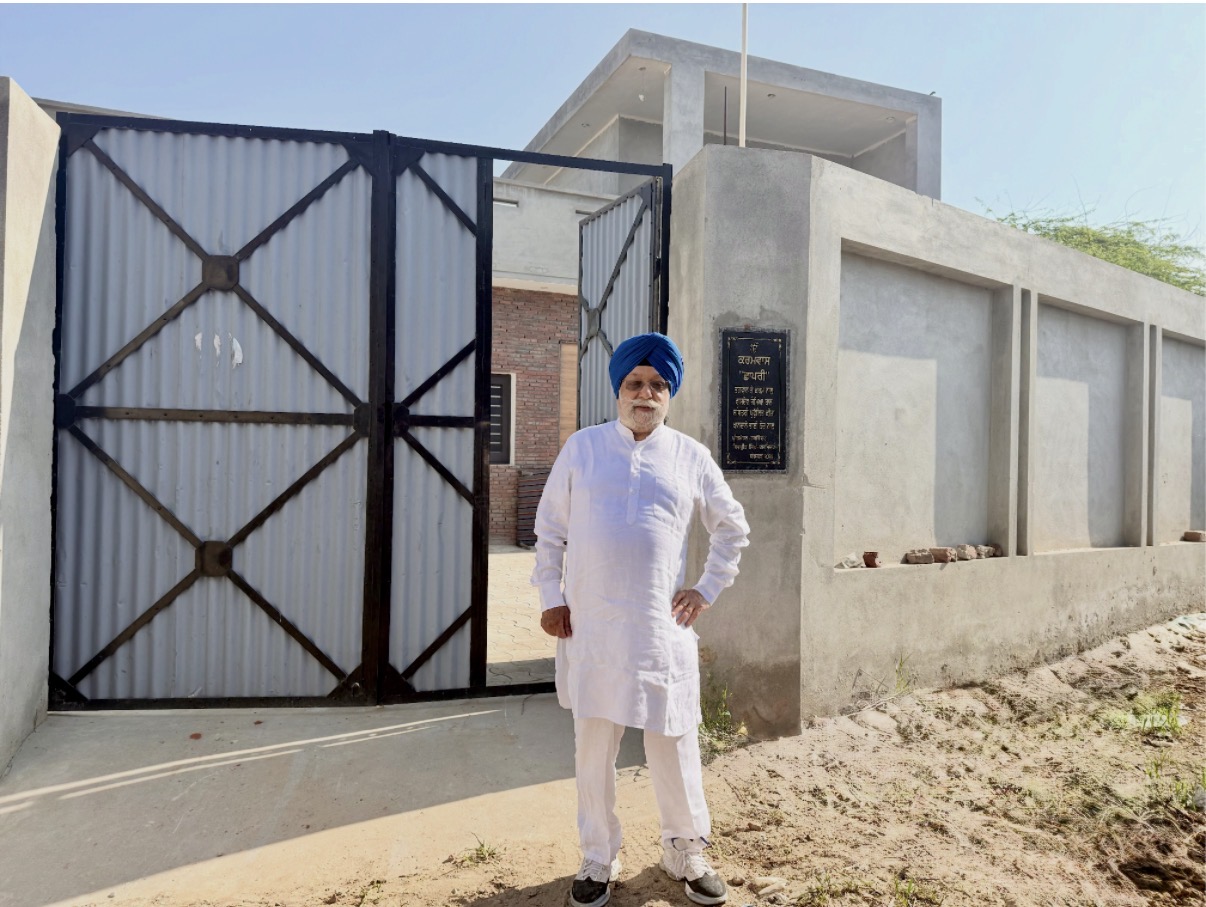
​ Proud Sardar Preetmohan Singh in front of his village houseBadbar Dist Barnala

If you ever happen to visit my village and ask the Patwari Saroanch or numberdar or anyone around about me, whether a man named Preet Mohan ever lived there, or where his house is, you may be surprised. Most people will not recognize my name.

Yes, they will recall that we were among the “Multani landlords”, those families who migrated from Multan (now in Pakistan) and were allotted land here after Partition. My family, along with my uncles, once held nearly 800 acres of land.

But names fade with time.

If you truly wish to find my home, you must ask in the language of the soil:
“Vasdev de munde di kothi Kithe hai?”

And then, instantly, directions will come alive.

They will guide you toward Gaganapati and just near the masjid, you will ind my house.
There, my identity still lives, not in records, but in relationships… in memory… in belonging.


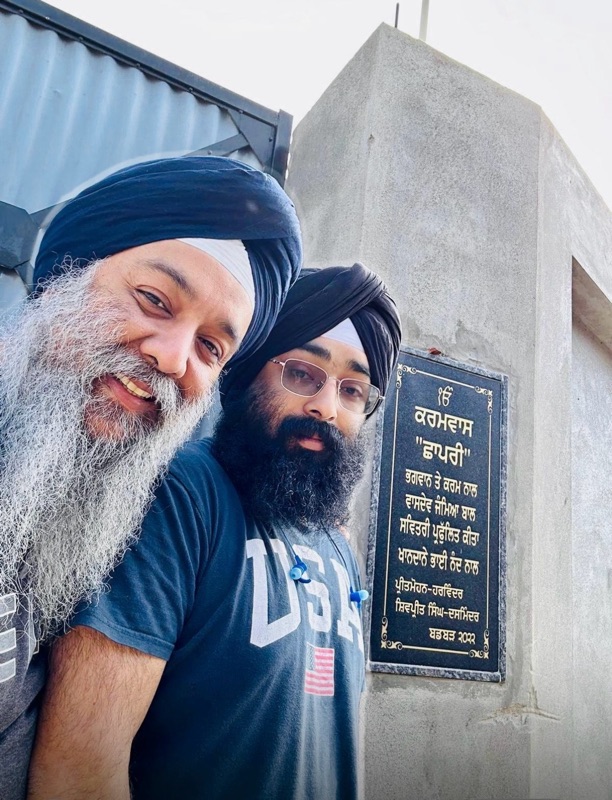
S Gobind joins his Dad Shivpreet

Just to make it easier for my co-villagers and strangers, I have erected a detailed name plate  showing my lineage and also attaching my Baba Ji’s name Bhai Nand Lal Goya the eminent poet Laureate in the court of Tenth Guru Gobind Singh.


Friday, April 24, 2026

Waheguru the Inner Thermometer


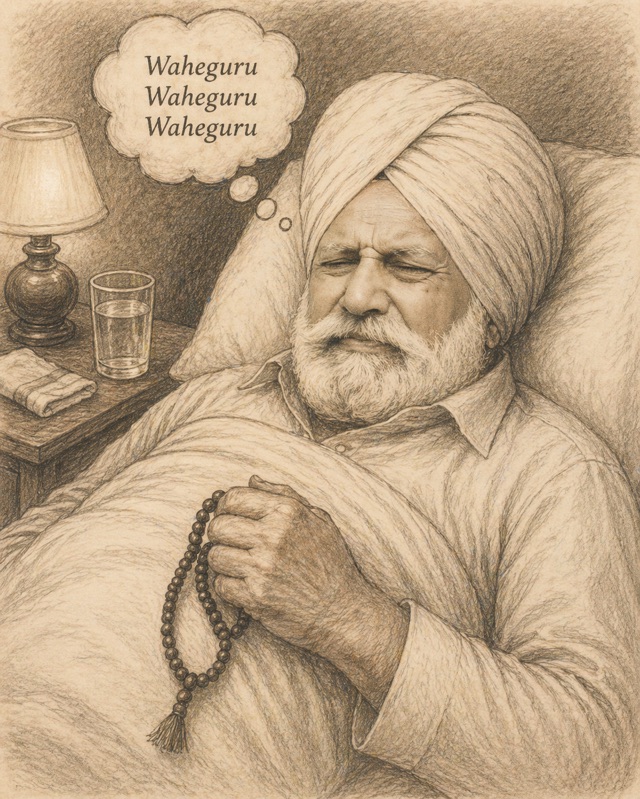
AI Sketch of my Dad S Vasdev Singh


Being a Sikh, I was always taught by my parents and elders to remember Waheguru in joy, in distress, and in every moment of life. It is our way of accepting His will and staying in gratitude.

As a child, my mother would often tell me about my father. Whenever he fell ill or had a high fever, he would automatically begin reciting, “Waheguru, Waheguru, Waheguru.”
She would gently say, “The way he is taking Waheguru’s name, I can tell his fever is high.”

In those days, we would smile at this… almost take it lightly.

But life has its own way of bringing understanding.

Recently, during our cruise to Hawaii, I was troubled by severe eczema triggered by an allergy. One night, in the middle of sleep, I found myself repeatedly uttering, “Waheguru, Waheguru…” aloud.

Harvinder woke up and asked, “What happened? Why are you saying Waheguru in the middle of the night?”

I did not have an answer at that moment.

But in the morning, I understood.

I was unwell… and somewhere deep within, my soul had responded the same way my father’s used to.

That day, I truly felt what he must have felt.

What once seemed like a habit… revealed itself as a connection, a natural turning toward the Divine in times of need.

Waheguru… becomes not just a word,
but an inner thermometer of the soul.


Thursday, April 23, 2026

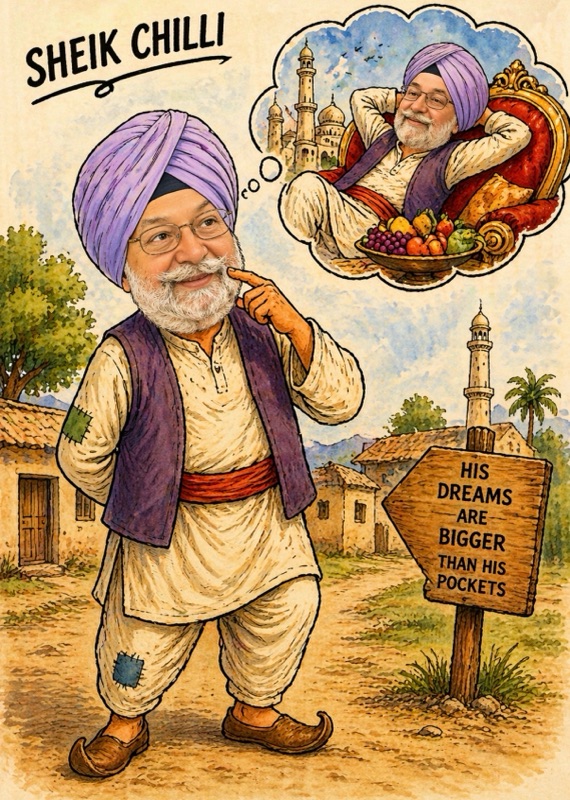
Me as Sheik Chilli in the eyes of my Mother


Sheikh Chilli lived in dreams, building grand castles in the air, only to watch them disappear in a moment of excitement.

My mother would often compare me to Sheikh Chilli.
I must have been the same, talking big, dreaming endlessly, unaware of how fragile those dreams were. I do not even remember my words, but I do remember her laughter, light, affectionate, never dismissive.

And then, there were those quiet moments…

While she worked tirelessly, cooking, cleaning, caring for five children of all ages. I would sometimes catch her smiling to herself. Not at me, but for me. As if in her heart, she was already seeing a future I could not yet understand.


My mother Savitri Devi a very shy dancer is forced to move her feet on my Shagan ceremony in Panipat while a band plays on.


She never said much, but her silence was full of prayers.

From deep within, she was blessing me—asking for a life of health, dignity, and worldly success for her son.

But destiny had its own timing.

She did not stay long enough to see those dreams take shape…
to see me build, to see me grow, to see our inherited lands and homes flourish.

My father stood beside me in the world of action, guiding, supporting, shaping reality.


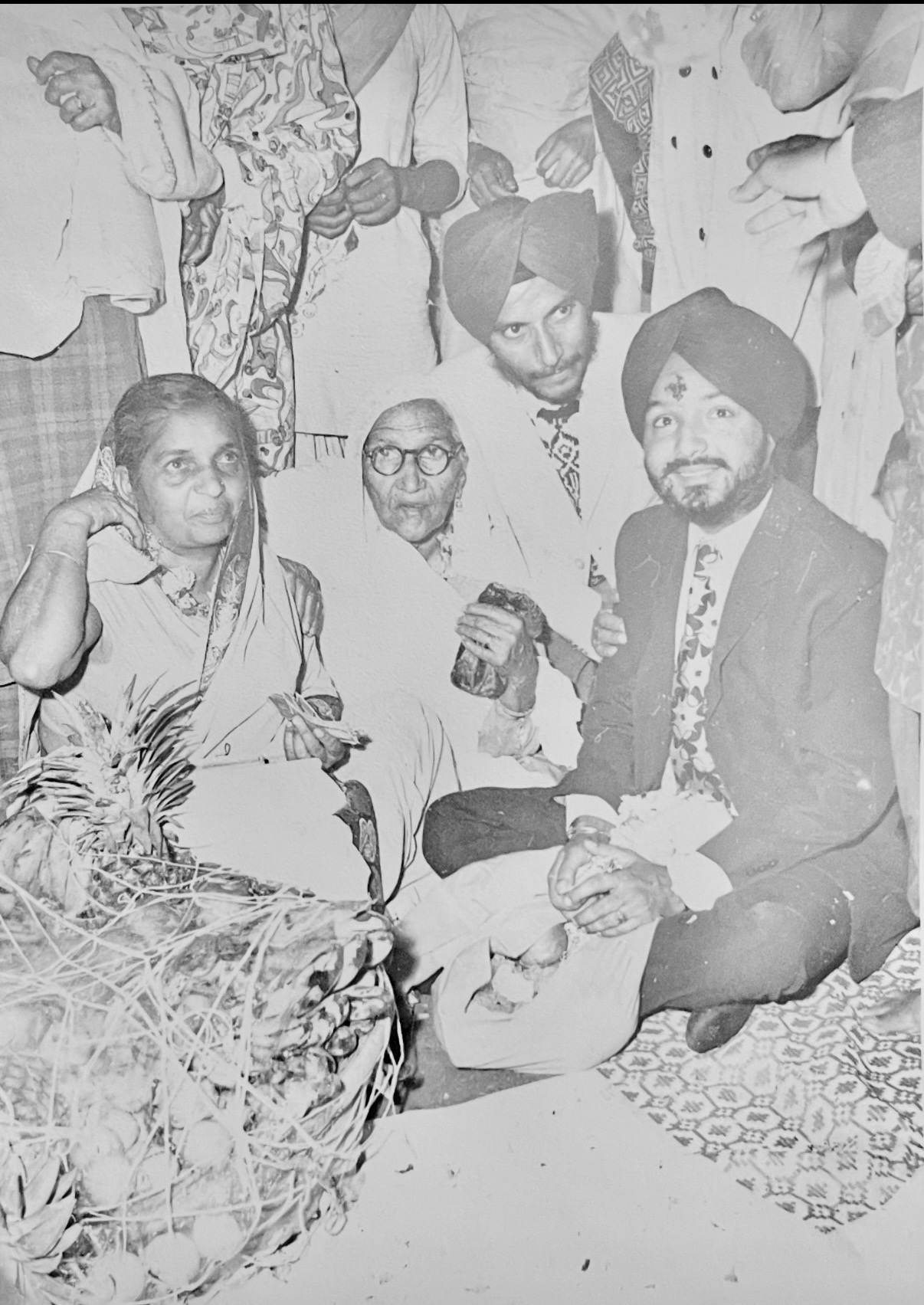
With my mother Savitri Devi and grand mother Karam Devi on my Shagan in Panipat


And my mother…
she remained my unseen strength, her blessings continuing, perhaps from heaven, quietly turning those once fragile “castles in the air” into something real.


Dastar Bandi and Power Outage


“Dastar Bandi and the Night the Lights Went Out”


This photograph captures a day of deep pride and joy in our family.

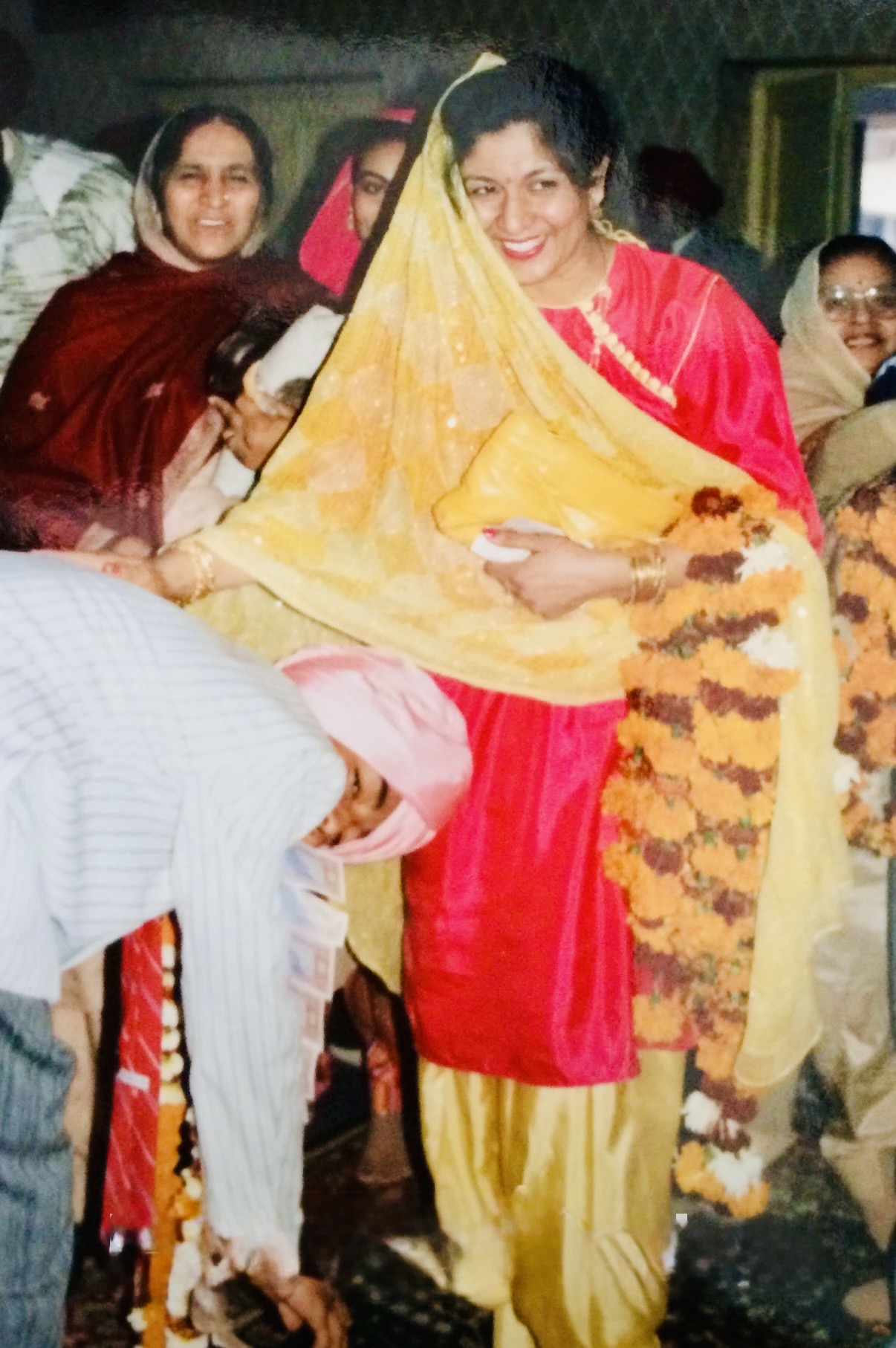
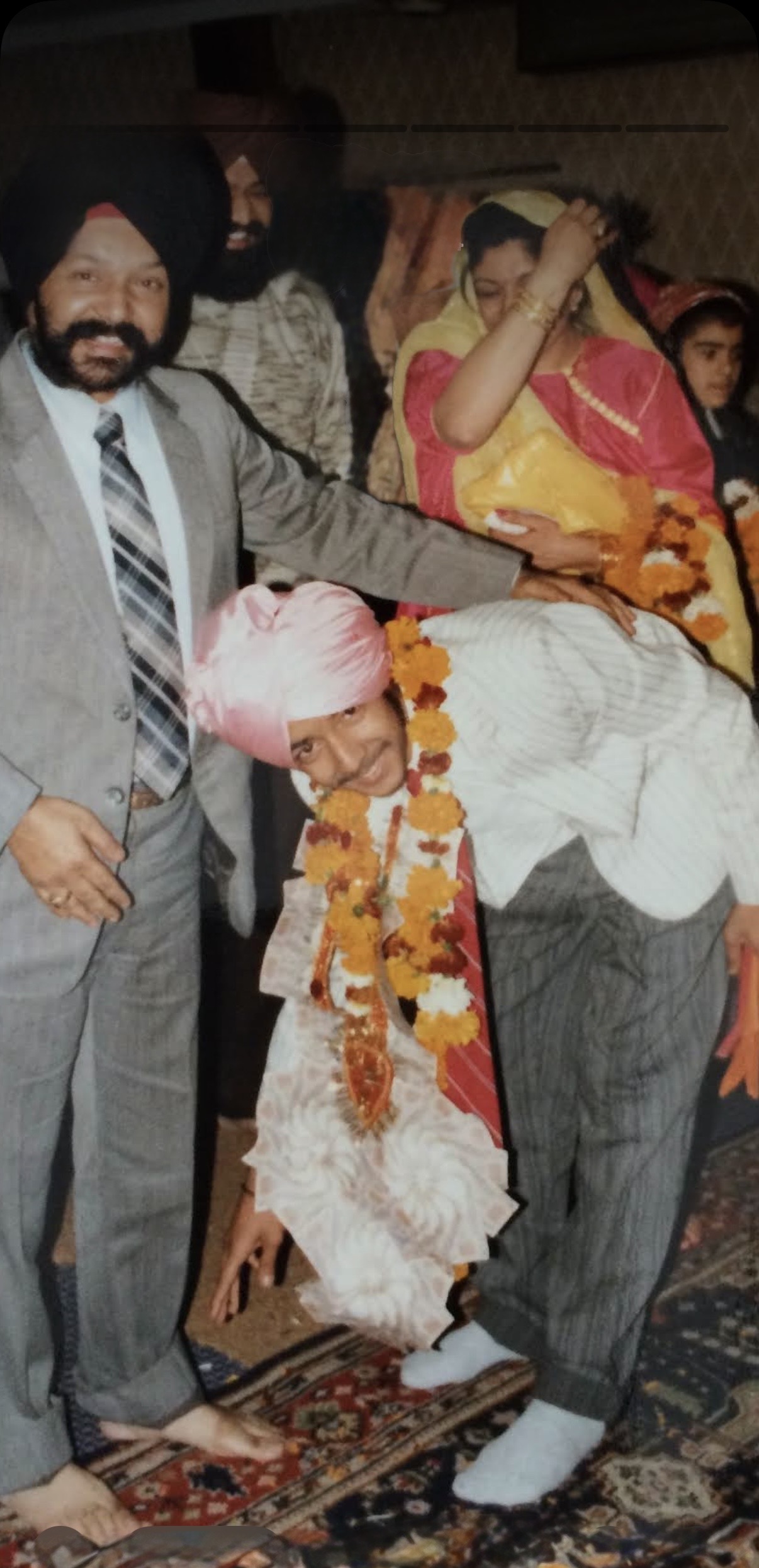
We had arranged on 8th Jan 1989, the Dastar Bandi of our son Shivpreet at the local Sri Guru Singh Sabha Gurdwara in Jangpura Extension. After the turban was respectfully tied by the Bhai Sahib, Shiv is seen here bowing to touch the feet of his mother, Harvinder, a moment of family values, humility, and grace.

Even today, the picture feels so fresh, so alive.


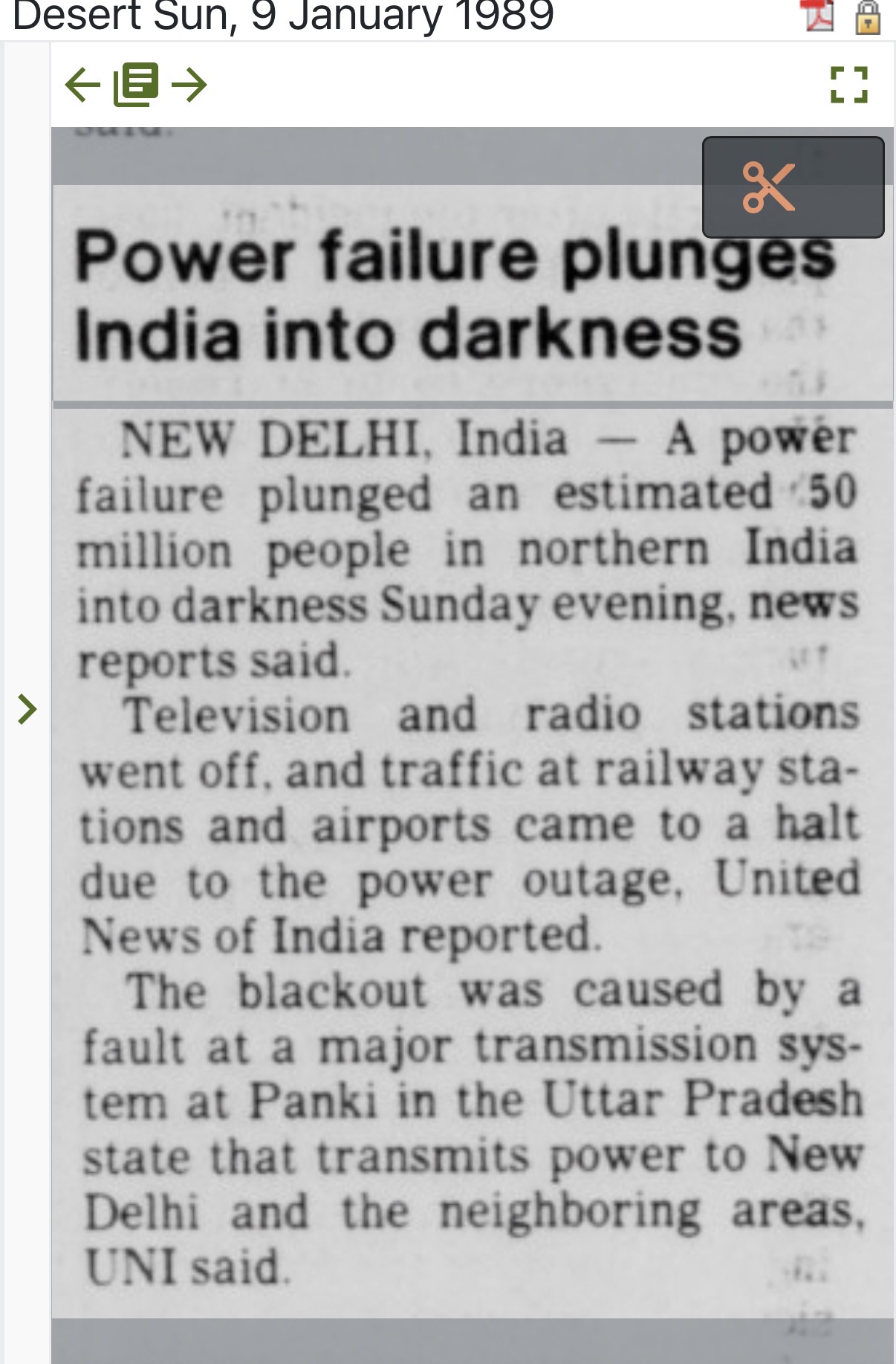
The very next day, on Sunday, January 9, 1989, we hosted a lively “Hollywood-style” gathering at our home in Jangpura. Many of my friends from the power sector were present. The evening was in full swing when suddenly, a major power outage struck.

Phones began ringing. Those connected with Northern Regional Load Dispatch Centre (LDC) were urgently called back to duty. Many of my office friends had to leave, it was no longer a party, but a moment of national responsibility.

By coincidence, another eminent personality from the power sector, Mr. Harish Khanna, Chairman of the Haryana Electricity Board and my cousin, was also present with his family. He immediately cautioned the family to guard the ladies of the family who were wearing gold Jewelry on the occasion.

What was celebration one day… turned into crisis management the next.


The widespread outage, affecting millions, was later reported in newspapers, as reflected in the clipping shared above.

Life has its own way of weaving joy and duty together.


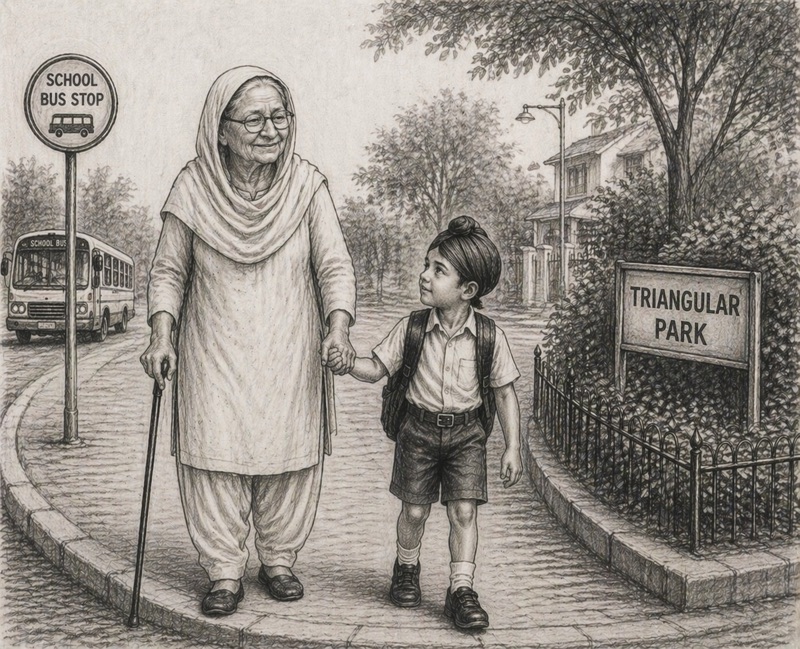
When my mother Biji picked Shivi from his School Bus stop

AI sketch of my mother Savitri Devi and Shivpreet

In her final days, she had become very fragile. Her balance was unsteady, her speech not always clear. Yet, every day she would insist on going to the bus stop at the end of our lane to see my four/five-year-old Shiv.


She would get ready well in advance, anxious, eager, almost restless, just to drop him and later bring him back from his Bus engaged by his Tiny-Tots Pre-School, his first tele-tots days near Moolchand Hospital, Lajpat Nagar III.


One day, I saw something that stayed with me forever.


Instead of her guiding Shiv across the road, it was little Shiv holding her hand tightly, carefully helping her cross the lane. She walked slowly, almost dependent on him.


I rushed forward and asked, “Why do you go to pick him when you can hardly see or walk properly?”


She smiled and said,
“I am so happy to go for him… in many ways, your son is better than you, Preetmohan! You will see, he will grow into a great person and surpass everyone in the family.”


Her words were simple… but filled with a vision only a grandmother could carry


Tuesday, April 21, 2026

Folded Clothes and Unfolding Life


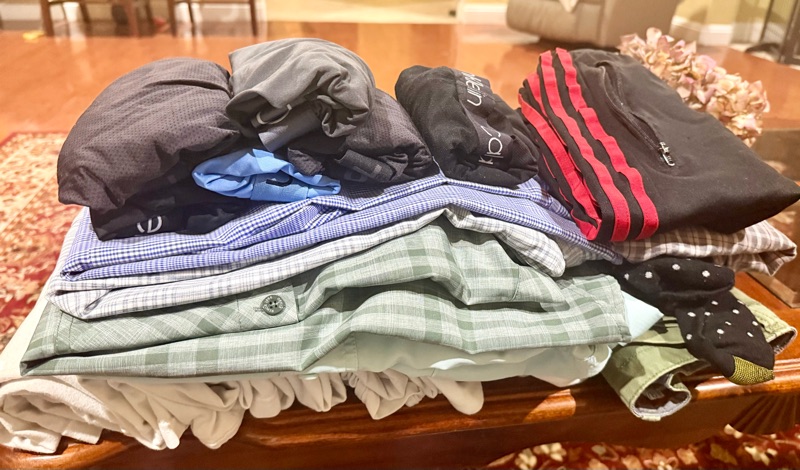
My full load of weekly clothes, my turbans and dress shirts and pants not included.


While folding my freshly washed clothes, my son Shivpreet was sitting beside me. I smiled and said, “Sunny, I am sure I will live for at least one more week, my clothes are ready for the week ahead.”

How easily we say such things… and yet, how difficult it is to truly understand life.

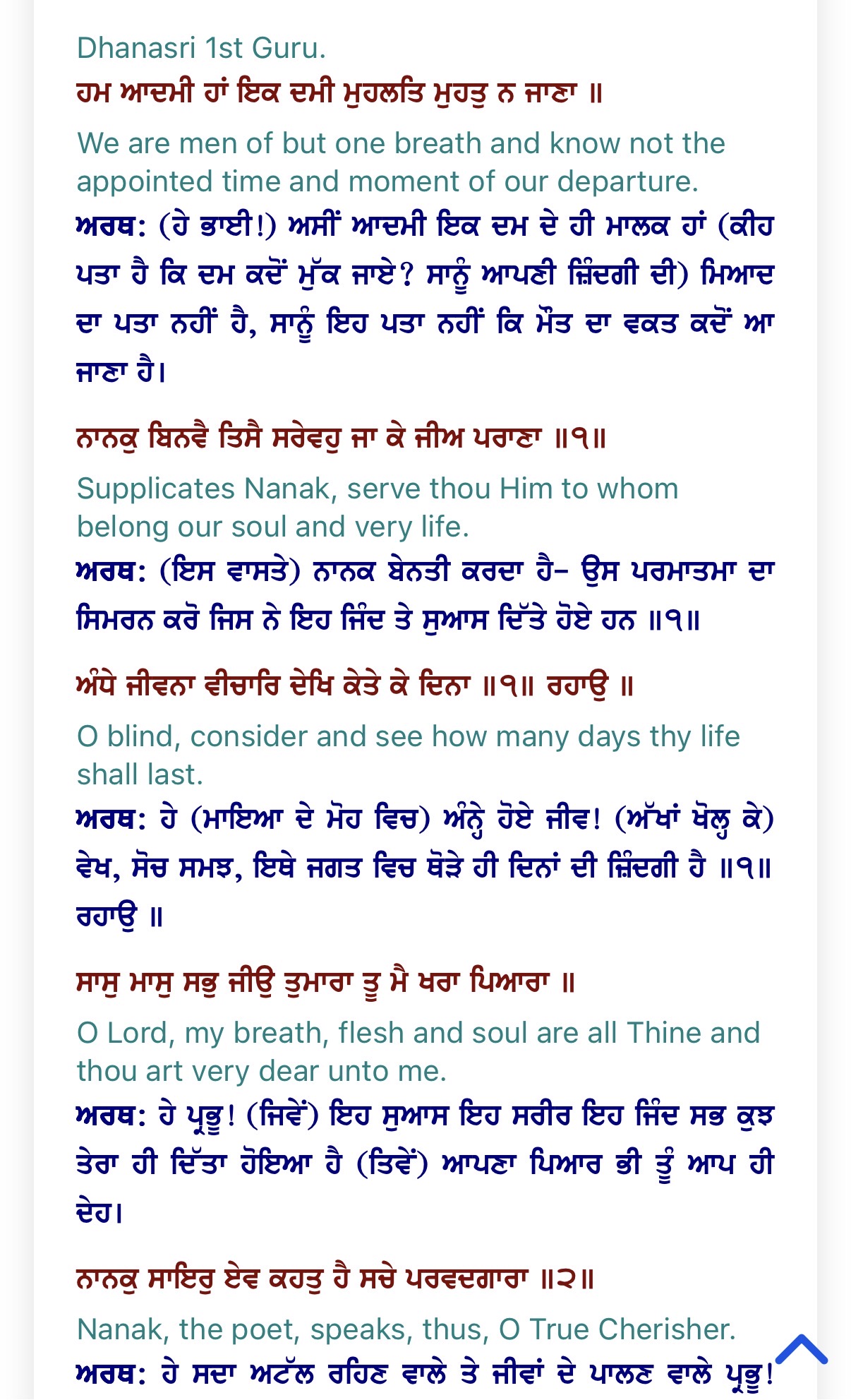
A breath goes in… who knows if it will come out again? Such is the fragile thread of our existence.

Guru Nanak Dev ji says below on P 660 of 

SGGS

Page 660 of SGGS with translation.

And still, in these small preparations, in folded clothes, in quiet moments with our children - we find a strange comfort, a gentle assurance that life will go on, at least for a little while longer.

I make it a point to wash my nightwear and daily-use clothes myself. Harvinder often blesses me, saying we can get help or that she will do it for me, but I prefer doing it on my own. It gives me a chance to use my own hands, eyes, and mind. Above all, it pulls me away from screen time, whether it is TV, the computer, or headphones.

This small routine keeps me active, engaged, and fresh.