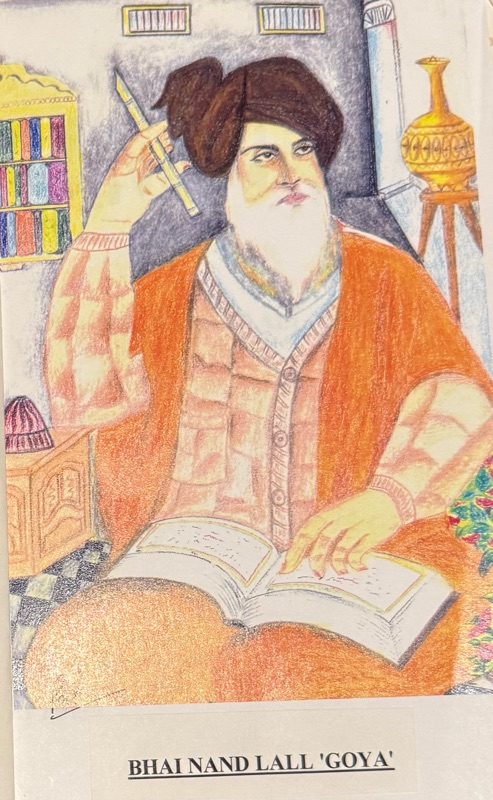
Bhai Nand Lal and his ancestors.
Nothing certain can be said at this time regarding the original homeland of Bhai Nand Lal's ancestors. Historical books and family traditions do not provide much help in this regard. However, his arrival in Punjab to seek refuge and presence before Guru Gobind Singh Ji during times of crisis confirms to some extent that his family already had a connection with the land of Punjab and the Sikh Gurus. It was this devotion that inspired Bhai Nand Lal to surrender his life, wealth, religion, and faith to them.
Bhai Nand Lal’s father, Chhajju Mall, was, perhaps, an accomplished scholar of Persian and Arabic. During the Mughal reign, scholarship and personal merit were the only means through which a non-Muslim or a Hindu could become an official in the imperial administration. During the time of Shah Jahan, Munshi Chhajju Mall reached Delhi in search of employment and was employed in the royal secretariat (Munshikhana). Delhi was the Mughal capital at that time. Here, Munshi Chhajju Mall met Prince Dara Shikoh. Dara was a fine scholar of the Sanskrit language and Indian knowledge and held Hindu scholars in high regard. His own writings, and the Persian translations of Sanskrit texts prepared under his supervision or according to his wishes, are living testimonies to this fact.
The scholarship and honesty of Munshi Chhajju Mall earned him such a place in Prince Dara Shikoh’s heart that when Emperor Shah Jahan sent the Prince on the first expedition to Qandahar in 1639 AD, he took Chhajju Mall along as his Mir Munshi (Chief Secretary). After arriving there, Munshi Chhajju Mall was appointed to the position of Diwan, and many financial, administrative, and military matters were entrusted to him. The Prince returned from Qandahar soon after, but Munshi Chhajju Mall remained stationed there and passed away there around 1652 AD.
By God’s will, no children survived in the home of Munshi Chhajju Mall during his early life...did not survive. Children would die at a very young age. Until the age of fifty, none of Chhajju Mall's children survived. Therefore, when Nand Lal was born in his later years, there was no particular celebration. The exact place and date of Nand Lal Ji's birth cannot be obtained from any reliable source. Due to the absence of family documents, even Bhai Mehar Singh and Bhai Ram Dial, who were from this lineage, did not discuss this in their writings. However, Shri Parmanand Arora, M.A., in his essay "The Life and Works of Bhai Nand Lal," has given the birth date as 1633 AD and the location as Ghazni.
But these two facts can only be accepted as correct if we assume that Munshi Chhajju Mall had gone there before Prince Dara Shikoh’s expedition to Ghazni. In 1630 AD, Dara Shikoh was only fifteen years old. He was born on 28 Safar, 1024 Hijri (March 20, 1615 AD). By that time, he had neither received the governorship of Kabul nor had he been appointed to Ghazni during the Qandahar expedition (this expedition took place six years later in 1639 AD), during which he could have taken Munshi Chhajju Mall with him. Lala Parmanand has not disclosed the source of his information, making it somewhat difficult to accept his conclusion as definitive.
However, without reliable and satisfying historical evidence, it is also difficult to dismiss family traditions as entirely false. Therefore, for the time being, we must accept that Munshi Chhajju Mall went to Ghazni with Prince Dara Shikoh in 1639 AD, and Bhai Nand Lal must have been born before this in Agra or some other place. Bhai Nand Lal likely received his education in Ghazni, and his childhood must have been spent there.
When Nand Lal passed the age at which the previous children used to die, Diwan Chhajju Mall began making proper arrangements for his education and upbringing. An Arabic and Persian scholar was appointed to teach him, and Diwan Chhajju Mall himself devoted a considerable amount of time to overseeing his son's education. Nand Lal was a promising and hardworking boy. He soon became proficient in reading and writing. He had a special interest in prose and poetry, in which he achieved great mastery.
Diwan Chhajju Mall was a follower of the Ramandi Vaishnav Bairagi sect. However, it appears that from childhood, the influence of the Sikh faith began to fall upon Nand Lal had already begun. What profoundly resonates with me is the striking resemblance between the compassion and clarity displayed by Guru Nanak Dev Ji and the stance adopted later in the Vaishnav tradition by the Ramanandi saints. When Guru Nanak Dev Ji, at a very young age, refused to wear the Janeu, it wasn’t an act of defiance but rather a profound expression of spiritual compassion. He questioned a practice that divided humanity and lacked genuine substance. Similarly, the rejection of the Kanthi in the Ramanandi Vaishnav tradition reflects a comparable understanding—that true devotion transcends the confines of outward symbols alone. Both instances serve as a poignant reminder that spirituality is not about external markers, but rather about inner purity, equality, and a sincere connection with the Divine.
Since the time of Guru Nanak Dev Ji, Sikh congregations (Sangat) existed in Afghanistan, and Sikh Dharamsalas (Gurdwaras) had been established in Kabul, Ghazni, and Qandahar. In these places, congregations would gather morning and evening to perform Shabad Kirtan (musical recitation of scriptures) and discuss the teachings of Gurmat. According to the author of Dabistan-e-Mazahib, there were many large cities in Northern India and Afghanistan where, at that time, there was not a place without Sikhs. This refers to the mid-17th century. In Afghanistan and Iraq, Sikhs generally worked as traders.
Thus, according to a family tradition, under the influence of Gurmat, Bhai Nand Lal refused his father’s repeated requests to take initiation from Bairagi Gurus or wear the ceremonial necklace (Kanthi). Instead, he expressed a desire to be adorned with a "rosary" (spiritual bond) that would never break and would help bring peace and tranquility to his life. This tradition mirrors the Sakhi (parable) of Guru Nanak Dev Ji refusing the sacred thread (Janeu) from Pandit Hardial.
Nand Lal was about sixteen years old when his mother passed away. Two years later, he also lost the guiding hand of his father. Lala Parmanand, in his essay, states that Diwan Chhajju Mall died in 1652 AD, which is likely correct. Being orphaned in this manner brought a mountain of troubles upon Bhai Nand Lal. Following the common custom, Bhai Nand Lal tried to secure his father’s official position, but his father’s benefactor, Prince Dara Shikoh, had already left Ghazni (and Bhai Nand Lal may not have known about the third expedition to Qandahar, which took place in February 1653 AD).
The new administrator was unaware of Diwan Chhajju Mall’s service or Bhai Nand Lal’s scholarly merits. Consequently, he paid no special attention to them and offered Nand Lal a low-ranking position as an ordinary scribe. However, Bhai Nand Lal’s self-respect would not allow him to accept such a post in the very place where his father had been a high-ranking official of the royal court. Now, he was in a foreign land without any support or helper. He also had the responsibility of looking after his two younger brothers. Nand Lal felt that he could no longer maintain his family traditions in the city of Ghazni, making it difficult for him to stay there. Therefore, he made up his mind to come to Hindustan (India).
In Ghazni, Bhai Nand Lal’s father, Diwan Chhajju Mall, had left behind considerable wealth and property. However, the money was scattered...
Key Historical Context from this Page:
• Sikhism in Afghanistan: The text highlights that Sikhism was well-established in the region long before the modern era, with active Gurdwaras and trading communities.
• Spiritual Independence: Even as a teenager, Bhai Nand Lal showed a preference for Sikh philosophy over his father’s Vaishnav traditions.
• The Turning Point: The death of his parents and a demotion in social/professional status acted as the catalyst for his migration to India, where he would eventually become one of the most celebrated poets in the court of Guru Gobind Singh
...In those days, he sold all his property, converted it into cash, and joined a caravan heading to Multan along with his two brothers and two Afghan servants. Multan had long been one of India’s famous cities. Its fame was not just due to political or religious reasons, but also because Multan had become a major commercial center between Afghanistan, Iran, Balochistan, and India. Therefore, this city was a significant hub for the merchants of Punjab and Delhi.
When Bhai Nand Lal’s caravan arrived here and his interactions with the local Hindu Khatris began to grow, he decided to settle down here. Outside the Delhi Gate, there were houses of some wealthy Khatris. Bhai Nand Lal took a house in the nearby vicinity and began living there, eventually building his own house. Gradually, other people also started settling there, and a fine neighborhood (Mohalla) was formed. It was here that he got married. His in-laws were devotees of the Guru’s house (Sikhism), which further increased the devotion and respect for the Sikh faith within his own home.
Bhai Nand Lal’s Afghan servants, who had come with him from Ghazni and stayed with him, used to address him as "Agha" (Master). Consequently, he became famous in Multan as "Agha," and because of them, this new settlement also became known as "Aghapura." Sir Edward Maclagan is of the opinion that this settlement was called Aghapura long before Bhai Nand Lal’s arrival because of the houses of Mughal "Aghas" and nobles. However, this view is not easily accepted. Firstly, no one addressed Mughals as "Agha," and secondly, the word "Pura" belongs to the Hindi dialect. Bhai Mehar Singh writes in his composition "Prem Fulwari" that this place was originally called "Agampura," which corrupted over time to become "Aghapura." Whatever the case may be, until specific historical evidence is found, the real origin of this name will remain hidden.
Lala Parmanand writes in his essay "The Life and Works of Bhai Nand Lal" that Munshi Nand Lal’s work "Dastur-ul-Insha" is a valuable treasure of the history of Multan and Punjab. The detailed accounts of the events of that time found in this work are not available anywhere else. This composition not only sheds light on the political and social affairs of the country but also provides a vivid picture of the ups and downs of Bhai Sahib’s own life...
Summary of Key Points:
• Settlement in Multan: Bhai Nand Lal chose Multan for its commercial importance and settled near the Delhi Gate.
• The Name "Aghapura": There is a historical debate whether the neighborhood was named after the respect his servants showed him ("Agha") or if it had older Mughal origins.
• Historical Source: The text highlights Dastur-ul-Insha as a primary historical source for 17th-century Punjab.
...presents before us how, in 1652 AD, by virtue of his proficiency and skill in Persian and Arabic, he was appointed to the post of Munshi (Scribe/Secretary) in the office of Nawab Wazir Khan, the Governor of Multan. The Nawab had long been acquainted with Bhai Sahib’s father, Diwan Chhajju Mall. However, his greatest recommendation was his own honesty and hard work, due to which he soon reached the position of Mir Munshi (Chief Secretary).
Later, he was also made the Fort Commander (Kiledar) and military commander (Faujdar) of Bhakkar. There, an order was issued to collect and send five thousand rupees as an advance or loan from the landlords of the nearby areas. He strictly implemented this order. Following this, he was appointed as the administrator (Nazim) of Dina Kehror, Fatehpur, and Pargana Muhi-ud-din Pur. But the highest position to which he was appointed was the Deputy Governorship (Naib Subedari) of Multan. From "Dastur-ul-Insha," it cannot be ascertained exactly how long he remained the Deputy Governor of Multan.
According to the writings of Lala Parmanand, "Dastur-ul-Insha" also mentions the military services of Bhai Nand Lal. In the hills around Dera Sultan Sarwar, a bandit named Shahu had gathered a force of about seven thousand and was causing great chaos in the country. Munshi Nand Lal was appointed with a large, powerful army to deal with the bandit Shahu. He displayed such military skill and bravery that Shahu the bandit was defeated in battle, and three thousand of his soldiers were killed on the battlefield. The rest either fled or went into hiding. Shahu himself was captured. Pledges of good conduct were taken from all the hill landlords, ensuring they would not create obstacles for caravans coming from Iran and other countries. This raised hopes for better commercial and political relations between India and other nations. Thus, Bhai Sahib served in various positions for nearly thirty years. He also had the honor of serving Prince Salim and Prince Muhammad Akbar (1678–79 AD).
However, nature intended to bring another great change into Bhai Nand Lal’s life. During the time of Emperor Aurangzeb, Bhai Nand Lal was dismissed from his service for some reason. The reason for this might have been that his father, Diwan Chhajju Mall, had been highly regarded in the eyes of Prince Dara Shikoh in Ghazni. Although Bhai Nand Lal, for his reinstatement...
Key Highlights:
• Political Rise: Bhai Nand Lal rose through the ranks due to merit, eventually reaching the prestigious position of Deputy Governor of Multan.
• Military Prowess: Unlike the purely poetic image many have of him, this text highlights his role as a successful military commander who suppressed a major rebellion.
• Shift in Fortune: His career took a hit during Aurangzeb's reign, likely due to his family's past association with Aurangzeb's rival brother, Dara Shikoh made efforts, but they were not successful. For a while, he went into seclusion and spent most of his time reading books on the Sikh faith. At that time, Guru Gobind Singh Ji, the Tenth Guru, occupied the Guru-gaddi (spiritual throne). His balanced management of both spiritual and worldly affairs (Deen-Duniya), his high scholarship, skill, and appreciative nature had amazed the world. Devotion to him was growing daily, and his followers were rising as a new, organized community. Because of this ever-increasing glory and power, the heart of the Mughal government was trembling. By God’s grace, a yearning to behold the Tenth Emperor (Guru) arose in Bhai Nand Lal’s heart. Arranging for the care of his young children, he left Multan and came to Lahore. After staying there for a few days, he reached Amritsar and paid obeisance at Sri Darbar Sahib. Then he set out for Makhowal (Anandpur), where Guru Gobind Singh Ji was residing. It only took one glimpse (Darshan) for him to become such a devotee that he never wanted to leave that door again.
From Anandpur, Bhai Nand Lal went to Agra. In those days, Prince Mu'azzam employed Bhai Sahib. It appears this was at the beginning of 1689 AD, after the Prince was released from imprisonment and appointed as the Governor of Agra in May. But nature did not intend for Bhai Sahib to stay in Agra for long either. It is said that once, in a gathering of Islamic scholars, Emperor Aurangzeb asked for the interpretation of a certain verse (Ayat) from the Holy Quran. Many tried to explain it in detail, but the Emperor was not satisfied. Prince Mu'azzam was also present there. He asked the Emperor for some time so that he could contemplate the meaning of the verse. During that time, the Prince sought the interpretation from Bhai Nand Lal, in addition to other scholars.
The Prince found the meanings explained by Bhai Sahib to be correct, and when he presented the detailed explanation to the Emperor, he too was satisfied and very pleased. When it was discovered that these interpretations were provided by Bhai Nand Lal, he was summoned and given a great reward. While talking, the Emperor said to the Prince that it was a matter of wonder that such a scholar and wise man had not yet entered the fold of Islam. Bhai Nand Lal sensed the Emperor’s intentions. For him, only two paths remained: either to become a Muslim or to move to some other safe place. The thought of embracing Islam could not even enter his mind, for he had already entered the congregation of Guru Gobind Singh, the Master of both worlds and the protector of life and heart...
Historical Significance of this Page:
• The Interpretation Incident: This is a famous historical anecdote where Bhai Nand Lal’s superior knowledge of Arabic and the Quran actually put his life in danger, as Aurangzeb became determined to convert such a brilliant mind.
• The Shift to Anandpur: This event marks the final transition of Bhai Nand Lal from a Mughal official to a devoted court poet of Guru Gobind Singh Ji.
• Prince Mu'azzam: The text notes his service to the Prince who would later become Emperor Bahadur Shah I; this relationship would later play a role in Sikh-Mughal diplomacy had already joined. Neither fear nor greed could shake this faith of his. He had full confidence in his true divine friend, Guru Gobind Singh. Finally, Bhai Sahib decided to reach Anandpur, and at the first opportunity, he came from Agra to Lahore. A student of his, Ghiyath-ud-din, who was the Daroga (superintendent) of Agra and was here on a month’s leave, lived in Lahore. He met Bhai Sahib, and both reached the presence of Guru Gobind Singh Ji at Anandpur. After a few days, Ghiyath-ud-din returned to Lahore, but Bhai Nand Lal remained there at Anandpur.
In history, Guru Gobind Singh is famous not only as a spiritual leader or a military general. He was also a spiritual poet of his time, a great scholar, and a grand patron of knowledge and art. At that time, there was perhaps no other place in India besides Anandpur where so many scholars, poets, and writers were gathered at once. Famous poets of Punjabi, Braj Bhasha, and Persian, numbering up to 52, were members of Guru Gobind Singh Ji’s literary court. In addition to their original compositions, they translated books of various subjects to enrich the treasury of Punjabi literature.
In this regard, when we look at Guru Gobind Singh’s own compositions in the Dasam Granth, we are left amazed. For a leader of a spiritual and religious movement—whose blood the powerful Mughal government had been thirsty for for the past hundred years, whose first five ancestors had to face the atrocities of that government and were martyred by the orders of the rulers of the time, whose two innocent children were bricked up alive and killed, and where not only local Mughal officials but even the surrounding Hindu Hill Rajas were his enemies, and who from an early age heard the drums of mortal danger, and who had to fight fourteen battles in twenty years to protect life and property, and who finally had to sacrifice his own life at the young age of 42—to produce such a vast amount of literature was a miracle.
But even more astonishing than that was what Guru Gobind Singh achieved: the concept and birth of the 'Khalsa'. That is, to create—from the downtrodden Hindu classes divided by centuries of caste and helplessness—an invincible, self-respecting, patriotic, and national-service-oriented community in just a single moment, which in fifty or sixty years...
Key Highlights of this Page:
• The Flight to Anandpur: Assisted by his loyal student Ghiyath-ud-din, Bhai Nand Lal finally escaped the threat of forced conversion in the Mughal court.
• The 52 Poets: The text emphasizes Anandpur as a premier center of 17th-century Indian literature, where the Guru patronized 52 poets across multiple languages.
• The Miracle of the Pen and Sword: The author reflects on the incredible feat of the Guru producing high-quality literature while simultaneously fighting constant wars and facing extreme personal tragedies.
• The Khalsa: The page ends by introducing the revolutionary transformation of the common people into the Khalsa.
Bhai Nand Lal Ganthavali (Page 8)
...liberated Punjab, which had been enslaved for hundreds of years. Soon, the borders of the Punjab kingdom were extended from the Sindh to Tibet and China, and from the rivers of Afghanistan to Delhi. Such a vast Punjab, which the 'Khalsa' established during the 18th and 19th centuries, had never existed before in the history of India, nor has it been established since.
The truth is that from a geographical and historical perspective, the unity and organization of Punjab was a unique gift from Guru Gobind Singh’s Khalsa to the whole of India, for which we all should be indebted to him. It appears that Bhai Nand Lal witnessed the birth of the Khalsa, its rising spirit (Chardi Kala), and its high glory with his own eyes. He depicted the praise of the Khalsa and the map of its duties at the end of his composition 'Tankhah Nama'. It is a living testimony of this.
As we mentioned earlier, Bhai Nand Lal had a passion for poetry and poetic composition from the very beginning, and during his days of education, he had achieved great mastery in this art. Through the study of books on the Sikh faith, his interest in devotion to the Guru and divine love had increased. In the spiritual and literary atmosphere of Anandpur, Bhai Sahib’s poetry was completely transformed. Under the influence of the radiant sight (Noorani Deedar) and divine initiation from Guru Gobind Singh, the doors of Bhai Nand Lal’s consciousness opened, and springs of inspiration burst forth. An ocean of divine love began to surge, resulting in devotion-filled poetry flowing naturally from him.
The very first composition he presented to Guru Gobind Singh Ji in Anandpur was 'Bandgi Nama' (The Book of Worship). The Guru ordered this composition to be recited to the congregation (Sangat) in the evening. When Bhai Sahib recited his work, the entire Sangat erupted in praise, exclaiming "Blessed, Blessed!" (Dhan Dhan). After the conclusion, the Guru greatly praised Bhai Nand Lal’s scholarship and skill. He took his own blessed pen and wrote a verse at the end of the book, decreeing that the name of this work should more appropriately be 'Zindagi Nama' (The Book of Life):
Zi aabi haiwan pur shud chu jami-o,
Zindagi-nama shuda jan nami-o.
(Translation of the Persian verse: Since its cup was filled with the water of life, it became known by the name 'Zindagi Nama'.)
The Guru wished to appoint him to the position of Diwan, but Bhai Sahib considered the service of the Langar (community kitchen) to be the most supreme. Among all the encampments (Deris) in Anandpur, Langars were operational in every single one. In the same way, Bhai Sahib...
Key Highlights:
• Legacy of the Khalsa: The text credits Guru Gobind Singh with creating the foundation for a sovereign Punjab that eventually stretched from China to Afghanistan.
• From Bandgi to Zindagi: A significant moment where the Guru transforms the title of Bhai Nand Lal's book, suggesting that true worship (Bandgi) is synonymous with a vibrant, spiritual life (Zindagi).
• Humility in Service: Despite his high status as a scholar and former Mughal official, Bhai Nand Lal preferred the humble service of the Langar over a high political office like Diwan.
...A Langar was also established in his own camp, from which the needy could receive food (Prasad) at any time. Bhai Sahib always remained present for the service of the Langar. Once, upon hearing various comments about the Langars in different camps of the Sikh congregations, the Guru, in disguise, visited all the camps. He observed that only in Bhai Nand Lal’s camp was the Langar ready at all times, and whatever was available, he would humbly serve it with his own hands.
After some time had passed during Bhai Nand Lal’s stay in Anandpur, a messenger arrived from Multan with news of the well-being of his children. When the Guru learned about the location of his home and children—that they were living in Multan at their maternal grandparents' house—he suggested to Bhai Sahib that, if he agreed, the Guru would send Hukamnamas (edicts) to the Sikh congregations to show them honor and respect. He also intended to decree that any offerings (Bheta) made to his children would be considered as accepted by the Guru’s court.
However, Bhai Sahib humbly requested with great respect that he and his family had been in service (employment) for a long time, having served as Diwans for Princes and Nawabs, and by the Guru’s grace, they were living well. He remarked that accepting offerings would instill a habit of eating for free, from which his descendants should be spared. He asked the Guru to bless his lineage with the strength to continue earning an honest living (Nek Kamai). Upon hearing this, the Guru was immensely pleased and remarked: "Blessed are you, Bhai Sahib; Blessed is Bhai Nand Lal."
In those days, around 1691 AD, another poet and scholar, Kunwar Sain (son of Keshav Das Bundelkhandi), came to seek refuge with Guru Gobind Singh Ji out of fear of Emperor Aurangzeb. The Guru included him among his court members and granted him a handsome salary. In this way, a large gathering of poets and scholars had assembled in Anandpur during Bhai Nand Lal’s time, benefiting from the Guru’s patronage and appreciation.
But the love and devotion that had blossomed in Bhai Nand Lal’s heart for the spiritual teachings of Guru Gobind Singh and the Sikh faith was something few other scholars were fortunate enough to grasp. Testimony to this is found directly in Bhai Sahib’s compositions, which truly interpret his inner feelings. The Guru also held immense grace for him; he would address him as "Bhai Sahib" and...
Key Highlights:
• The Test of the Langar: This page recounts a famous tradition where Guru Gobind Singh disguised himself to test the hospitality of his Sikhs, finding Bhai Nand Lal’s service to be the most sincere and ready.
• Ethics of "Nek Kamai": Bhai Nand Lal’s refusal to let his family live on religious tithes/offerings highlights the core Sikh value of Kirat Karo (earning an honest living through physical/intellectual labor).
• Literary Haven: The arrival of Kunwar Sain illustrates how Anandpur became a sanctuary for intellectuals fleeing the restrictive policies of the Mughal Empire.
Would you like to continue to the next page?
...recitations of his compositions were common in the court. Even today, you are requested to visit Sikh Gurdwaras to hear them. In the Sikh world, especially at Sri Darbar Sahib Amritsar, it is permitted to perform Kirtan (spiritual music) of the compositions of Bhai Nand Lal and Bhai Gurdas alongside Gurbani. This is a matchless honor and respect in the Sikh world, which was granted only to Bhai Nand Lal after Bhai Gurdas.
Bhai Nand Lal remained in the court of Guru Gobind Singh Ji at Anandpur until December 1704 AD. It appears that when Anandpur was besieged and the Guru had to leave his residence, and the entire family was separated and the Sikhs were scattered on the banks of the Sarsa River, Bhai Sahib also became separated. Where he remained during the year 1706 AD is not known. However, it is known that after the death of Emperor Aurangzeb in 1707 AD, he once again entered the service of his former master, Prince Mu'azzam (Shah Alam), who by that time had ascended the throne of Delhi as Bahadur Shah. On the other hand, Bahadur Shah’s younger brother, Prince Azam, was also claiming the throne and was advancing toward Delhi from the South with a massive army. At that time, Bahadur Shah’s heart was trembling with fear that he might lose in a confrontation with Azam. During this period, Guru Gobind Singh Ji had abandoned his plan to travel south and was returning toward Punjab from near Baghaur in Rajasthan when he received news of Aurangzeb’s death. When he arrived near Shahjahanabad (Delhi), Bhai Nand Lal, on behalf of Bahadur Shah, approached the Guru with a request for assistance.
Every ordinary person is amazed to see the Guru’s sympathetic treatment of Bahadur Shah at that time. Prince Mu'azzam’s father (Aurangzeb), grandfather (Shah Jahan), and ancestors had been staunch opponents and mortal enemies of the Gurus and the Sikh religious movement. Mu'azzam’s great-grandfather, Jahangir, had martyred Guru Gobind Singh’s great-grandfather, Guru Arjan Dev Ji, after inflicting terrible tortures. During the reign of Emperor Shah Jahan, four major Mughal military expeditions were launched against Guru Hargobind Sahib, though the Mughals had to face defeat every time. Similarly, Aurangzeb had attempted to summon the Seventh Guru, Guru Har Rai Sahib, to Delhi and...
Key Highlights of this Page:
• Canonization of Poetry: The text notes that Bhai Nand Lal’s Persian poetry holds a unique, semi-canonical status in Sikhism, being among the only non-Guru writings permitted for performance as Kirtan in the Golden Temple.
• The Sarsa River Separation: This refers to the tragic battle during the retreat from Anandpur where the Guru's family and followers were split apart.
• Political Mediator: Bhai Nand Lal’s dual loyalty—as a devotee of the Guru and a high official for Bahadur Shah—allowed him to act as a bridge, leading to the Guru supporting Bahadur Shah in the Mughal war of succession.
• The Guru's Forgiveness: The author remarks on the Guru’s magnanimity in helping the son of the very man (Aurangzeb) who had spent decades trying to destroy the Sikh movement.
...After summoning him to Delhi, Guru Har Krishan Ji passed away there. Finally, Guru Gobind Singh’s father, Guru Tegh Bahadur Ji, was martyred in Delhi’s Chandni Chowk. Guru Gobind Singh’s entire life was spent under the wrath of Emperor Aurangzeb; he had to face Mughal armies many times, and ultimately his home at Anandpur Sahib was destroyed. His entire family was lost, and his invaluable treasury of literary manuscripts was ruined. Two of his sons were martyred in the Battle of Chamkaur, and two were bricked up alive and executed in Sirhind, where his respected mother also passed away.
Guru Sahib had to endure countless hardships and troubles without a home or hearth. Yet, glory be to Guru Gobind Singh and his great purpose—his heart and mind remained perpetually balanced and steady. He rose above the fire of anger or revenge to promise help to Bahadur Shah in his time of trouble. On June 8, 1707 AD, in the battle that took place at Jajau, the Guru sent two to three hundred spear-wielding Sikhs to assist the rightful heir, Prince Mu'azzam (Bahadur Shah). Indeed, the following verse fits him perfectly:
...negotiations for peace and reconciliation had not yet reached a final conclusion. Therefore, Guru Sahib also set out toward the South (Deccan) along with the Emperor, so that discussions could continue along the way.
When the royal camp reached Nanded at the end of August 1708 AD, Guru Sahib established his camp at the site of a Bairagi (ascetic) named Madho Das. Nearby, in an open area, some Sikhs began cooking meat. This caused a great commotion among the ascetics of Madho Das’s camp and the local Hindus of Nanded. By God’s will, that very day (September 3, 1708 AD) was a solar eclipse and Masya (new moon). Both of these days are considered very sacred among Hindus. Although for the Sikhs, the movement of stars was merely a natural occurrence and they were free from such superstitions according to Sikh thought, when the Hindus of Nanded complained to Bahadur Shah, the Emperor investigated. He dismissed it as a trivial and baseless matter, which left the complainants feeling embarrassed.
Referring to this incident, Bhai Nand Lal, in his contemporary composition 'Amar Nama', writes about his own presence with the Emperor as follows:
Zi wajra-e-Sultan buda Nand Lal,
Suda hamrahe-shah-e-wala kamal.
This writing bears witness to the fact that in September 1708 AD, Bhai Nand Lal was present in Nanded in the capacity of a respected minister of Emperor Bahadur Shah.
Lala Parmanand Arora, in the aforementioned essay, writes that since letters in Bhai Sahib’s work 'Dastur-ul-Insha' mention Emperor Farrukhsiyar ascending the throne, it can be said without a doubt that Bhai Sahib was alive until at least 1713 AD. However, in the absence of any reliable historical writing, it cannot be determined exactly when he returned from the South to Punjab and under what circumstances he reached his home in Multan. It is generally estimated that upon the return of the Deccan expedition, when Emperor Bahadur Shah was near Ajmer...
Key Highlights of this Page:
• The Journey to Nanded: The Guru and the Emperor traveled together to continue their diplomatic dialogue regarding the grievances of the Sikhs against the Mughal local officials.
• Cultural Tension: The text highlights a moment of friction regarding dietary practices and religious superstitions, where the Emperor sided with the Guru's camp, viewing the complaints as insignificant.
• Bhai Nand Lal’s Status: The Persian verse from Amar Nama confirms that Bhai Nand Lal was not just a poet but held a high-ranking ministerial position (Wazir/Minister) in the Mughal court while maintaining his devotion to the Guru.
• Historical Longevity: Evidence from his own letters suggests he lived at least until 1713 AD, surviving both Guru Gobind Singh Ji and Emperor Bahadur Shah.
...When news of Baba Banda Singh Bahadur’s victories was received and he arrived in the plains of Punjab, Bhai Nand Lal was still with the royal camp in 1710 AD. After the death of the Emperor in Lahore, or shortly before it in 1712 AD, he went to Multan, where he eventually passed away.
Bhai Sahib spent the final days of his life in Multan in the service of the common people. Sensing the educational needs of the city's residents, he established a high-level school (Vidiala) where he arranged for education in elementary Persian and Arabic, as well as the highest levels of learning for both Hindus and Muslims without any bias or religious discrimination. Bhai Sahib himself served as the head teacher of this school. He guided every student in both spiritual and worldly matters with great passion and love, helping them solve their problems. According to Lala Parmanand, "The work of this great school continued in a fine manner even after Bhai Sahib’s life, and his descendants continued to supervise and patronize it in Multan until the establishment of British rule in 1849 AD." Even until the beginning of the 20th century, elderly people existed who, while passing in front of the window of that room in the old building, would bow their heads in respect, as they had received their education from this family in their childhood.
The Works of Bhai Nand Lal
As is evident from the style of Bhai Nand Lal’s writings, all his compositions were created under the influence of Sikh teachings after he presented himself in the service of Guru Gobind Singh Ji at Anandpur. The number of such compositions reaches up to ten. Among these, seven are in Persian and three are in Punjabi. In his poetry, he used the pen names 'Goya' and 'Lal'.
1. Zindagi Nama (Persian)
As mentioned above, Bhai Sahib prepared this composition immediately upon arriving at Anandpur and presented it to Guru Gobind Singh Ji under the name 'Bandgi Nama'. After studying it, the Guru was so pleased that he suggested changing the name from 'Bandgi Nama' (Book of Worship) to 'Zindagi Nama' (Book of Life). The subject of this composition is divine love and devotion to the Guru...
Historical Significance of this Page:
• Life After the Guru: Bhai Nand Lal survived the Guru by several years, eventually returning to his home city of Multan during the chaotic period of the Mughal succession and the rise of Banda Singh Bahadur.
• Legacy of Education: He is remembered not just as a poet, but as a pioneer of inclusive education who founded a school that lasted for nearly 150 years.
• Literary Identity: The text establishes his dual identity as a scholar of Persian (using the pen name 'Goya', which means "One who speaks") and a devotee of the Guru.
...These are generally taken from Gurbani (Sikh scriptures), and in many places, they are a line-by-line translation of the meanings and essence of the verses of Gurbani.
2. Gazaliat or Diwan-e-Goya (Persian)
This is the most famous work of Bhai Sahib, which has been published numerous times. Due to its intensity of poetic expression, loftiness of thought, and beauty of style, it is a unique and significant spiritual and ethical creation. It is a successful effort to translate the themes of Gurbani into Persian. For this reason, many translations of it exist in the Punjabi language.
3. Tashikh-ul-Sana and Khatima (Persian)
As is clear from its name, this work is related to the praise of God. Except for the Khatima (conclusion), the entire work is in prose. The abundance of difficult Persian and Arabic words has made it so challenging that perhaps common students were not able to pay much attention to it, and it was not even printed. Moreover, there isn't much historical substance or theoretical explanation in it. Therefore, the translation of the prose part has not been included here; only the Khatima has been taken.
The Khalsa Tract Society Amritsar had previously published the work 'Ganj Nama' (Tract No. 416) under the mistaken title of 'Tashikh-ul-Sana', which was later corrected.
4. Ganj Nama (Persian)
This is a combined work of prose and poetry in which the author has offered praises to all the Gurus, starting from the founder of the Sikh faith, Guru Nanak Dev Ji, up to the Tenth Sovereign, Guru Gobind Singh Ji, expressing his immense devotion.
5. Jot Bikas (Persian Poetry)
In this composition, the divine light (Noorani Jot) of the founder of the Sikh faith, Guru Nanak Sahib, is shown manifesting sequentially through the Gurus who occupied his throne. Guru Gobind Singh Ji is presented as a true messenger of God, a dervish-king, and a perfect human being. Before the Punjabi translation of this book, it was first published by Bhai Mehar Singh 'Gharib' through Gurdial Singh and Sons, Lahore, around 1715 Bikrami, corresponding to 1918 AD.
Key Highlights:
• Diwan-e-Goya: This is widely considered his masterpiece, known for bringing the essence of Sikh scripture to the Persian-speaking world through high-quality ghazals.
• Ganj Nama: A historic tribute that provides a poetic and reverent account of the lineage of the ten Sikh Gurus.
• Jot Bikas: This work explores the Sikh concept of Jot (Divine Light), explaining that the same spiritual spirit resided in all ten Gurus, culminating in the personality of Guru Gobind Singh Ji.was published.
6. Jot Bikas (Punjabi Poetry)
This book is not a literal word-for-word Punjabi translation of the Persian work of the same name, but rather an independent poetic creation.
7–8. Rahit Nama and Tankhah Nama (Punjabi Poetry)
Regarding these two compositions, the late Bhai Kahn Singh Nabha, the author of the Gur Shabad Ratnakar Mahan Kosh, is of the opinion that these are not the works of Bhai Nand Lal. Even if this view is accepted, both these compositions, the 'Rahit Nama' and 'Tankhah Nama', interpret the questions and answers between the seeker and the Guru (specifically between Bhai Nand Lal and Guru Gobind Singh). Therefore, it seems appropriate to include them in the collection of Bhai Sahib's works. The belief among the descendants of Bhai Sahib's family is that both these works are indeed his own. This was also the view of Sardar Attar Singh Bhadaur, as is evident from the English translation of 'Rahit Nama' by Bhai Nand Lal published by him in 1876 AD through Albert Press, Lahore. These have been published multiple times in Punjabi as well. While transcribing from Persian into Gurmukhi script, several errors crept in over time, which have been attempted to be corrected by matching them with manuscripts obtained from Bhai Sahib's family.
From the date and place mentioned at the end of the 'Rahit Nama', it appears that it was written in Anandpur on the banks of the Sutlej River on Thursday, Maghar Sudi 9, Samat 1752 (December 4, 1695 AD). The code of conduct (Rahit) mentioned therein dates back to a time when the 'Khalsa' had not yet been formally manifested (1699 AD), nor had Guru Gobind Singh Ji officially added the word 'Singh' to his name, which only came into common use after the creation of the Khalsa. The 'Tankhah Nama' is a composition from the period after the manifestation of the Khalsa, in which the words 'Khalsa' and 'Gobind Singh' are used in a general sense, and it concludes with a praise of the 'Khalsa'.
9. Dastur-ul-Insha (Persian Prose)
This is a collection of summaries of several letters that Bhai Nand Lal wrote to his friends, companions, and relatives from time to time. As mentioned earlier in the reference to Lala Parmanand’s essay...
Key Highlights of this Page:
• Authenticity Debates: The author addresses the scholarly debate initiated by Bhai Kahn Singh Nabha regarding the Rahit Nama and Tankhah Nama, noting that family tradition and other scholars still attribute them to Bhai Nand Lal.
• Pre-Khalsa Code: The Rahit Nama is identified as a pre-1699 document, providing a unique look at Sikh discipline before the formal initiation ceremony of the Khalsa.
• Linguistic Versatility: The page highlights Bhai Nand Lal’s transition from Persian (the language of the elite) to Punjabi (the language of the people and the Gurus) to communicate spiritual and social codes.
...This collection of Bhai Nand Lal's writings is not only a priceless treasure for the history of Punjab and Multan, but it also provides a great deal of insight into the life of Bhai Sahib himself. Lala Parmanand had personally examined the manuscript of 'Dastur-ul-Insha' within Bhai Sahib’s family, which now appears to have been lost forever. At least our search for it until now has not been successful. The manuscript we obtained through Bhai Bhagwant Singh 'Hari' Ji of Nabha is incomplete and does not contain all the details mentioned by Lala Parmanand. Nevertheless, whatever we have found has been included in this collection as it is considered important. No part of this had been printed until now.
10. Arzul-Alfaz (Persian Poetry)
This composition is a vast example of Bhai Nand Lal’s Persian and Arabic vocabulary and has been used throughout to praise the attributes and glory of God and the Gurus. It is a precious storehouse of specific words related to spiritual knowledge and philosophy. From this, not only can one estimate Bhai Sahib’s academic ability, but it also provides great help in understanding his other works. This writing was first published in the Persian collection Kulliyat-e-Bhai Nand Lal, but its value is largely literary rather than historical or religious. Its beauty can only be truly appreciated by scholars of Persian and Arabic, not by others. Therefore, the full translation has not been included here; only a few sample verses have been provided.
Key Highlights:
• Lost Manuscripts: The text notes the tragic loss of original family manuscripts, particularly the complete 'Dastur-ul-Insha', making the surviving fragments in this book even more significant.
• Arzul-Alfaz: Described as a masterclass in Persian/Arabic linguistics, this work serves as a philosophical and spiritual dictionary for Bhai Nand Lal's entire body of work.
• Preservation Efforts: This collection marks the first time some of these specific fragments have been brought to print for the public.
The above translation in English is as inspired by a chaptor on a book by Prof Ganda Singh on Bhai Nand Lal Granthavali with comments by author
Pm


No comments:
Post a Comment