


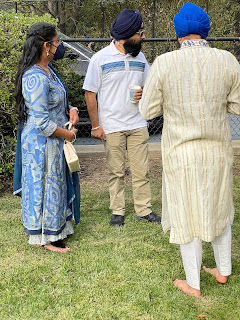


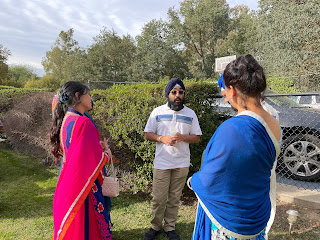


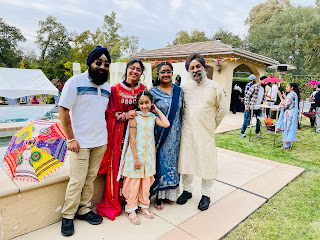


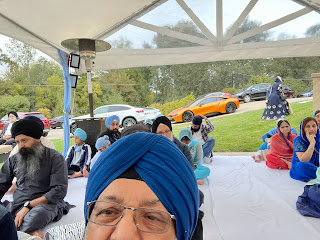





Finally you need need Love! In fact Love every where.

I found this well researched and very well documented article on Turban. My Dad and Uncle all used to use Mal-Mal F-74 fabric by Findlay’s as a texture and get it dyed in the color of his choice. The length was always 5 yards/meters as compared to 7.5 meters in Patiala shahi turban. My Dad in his last years of life stuck to dark brownish chocolate color. He would in fact color the stuff at home.
I also started adopting this style as my cousins in Chandigarh challenged me to do so in 1978/79. My youngest cousin Kaka (Jagjit Singh) spent whole day to teach me new style with 7 meters of cloth cut in half and then sewn together to double the width.
I also encouraged my brothers-in-law, Amritpal and Tejpal to adopt this style. A major advantage in this style was that we need not get it starched every time you wash as the double width supported the fluffy snd majestic style. Secondly repeated wearing/wrapping after each wash in hard and humid summers would not only lead to stinking odor invariably but also suppress the structure to hold itself.
THE PATIALA SHAHI TURBAN
Little is conclusively known of the origins of the turban. The earliest evidence of a turban-like garment is from Mesopotamia in a royal sculpture dating from 2350 b.c.e. Sculptures from Central India (100 b.c.e.) provide detailed visual evidence of the use of turbans. These headdresses were originally worn by royalty and spiritual leaders and used to commute power; often being adorned with jewels and accessories to display wealth and grandeur.
The turban as a headdress is not merely a fashion statement or cultural paraphernalia; it has symbolic meaning beyond the obvious. It serves to identify the wearer as a member of a particular group, tribe, or community, and serves as an introduction to their cultural, religious, political, and social orientations.
Turban is known by different names such as Pug, Safa, Pagri and Dastar. It is a symbol of honour and respect. Dastar has been an inseparable part of the Sikhs. Earlier, turban was worn by all communities because it was considered respectable to cover ones head.
The turban has significant associations with the concepts of respect and honor. A man's turban is supposed to signify his honor and the honor of his people. Pag Vatauni (exchange of turban) is a Punjabi custom, in which the men exchange dastaars with their closest friends. Once they exchange turbans, they become friends for life and forge a permanent relationship. They take a solemn pledge to share their joys and sorrows under all circumstances. Exchanging turban is a glue that can bind two individuals or families together for generations. Thus, the turban is an intrinsic part of all ceremonies from birth until death.
There are several styles of wearing turban. But the most ultimate and admired turban is the Patiala Shahi turban. Maharaja Bhupinder Singh of Patiala popularised ‘Patiala Shahi' turban. The colour of the turban played an important part in Phulkian States. The colours of the Patiala turban are always soft and light. Pink and lemon are regarded as the Patiala state colours. Faridkot colour is Hara Ferozi (turquoise). Nabha colour is maroon (it was called nabhi colour which was the Nabha state official colour). Jind State colour is orange. Other colors worn by Patiala men are Ghia kasoori (green), kesri, amarsi (mango colour) and motia (cream).
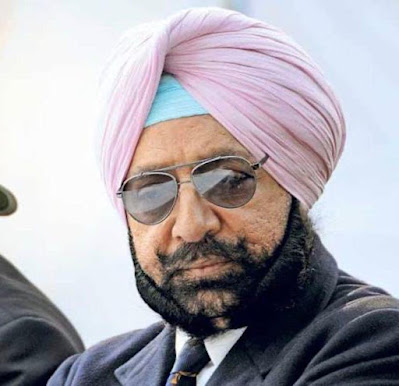


Patiala turban is world famous became of Patiala royals special style of tying it. It is not worn in a neat manner but the larhs of both sides of turban are in carefree style. The thumb is used to depress the cloth at the forehead to create the perfect, twist in the last larh. The tradition of leaving the ear lobe visible in the Patiala style is common as earlier the Sardars use to wear earrings (diamond studs). The contrast fifty (it is a band of cloth worn under turban which is especially sewn in neat layers in the centre) is a must .The Patiala fifty is specially made of many neat layers only in the centre of the fifty. It is worn under the turban which gives a triangular effect. Other requisites of the Patiala turban include use of Finlay‘s "F-74 mal-mal" fabric, at least seven-and-a-half meters of it, which is cut in half and sewn together to double the width. The F-74 mal-mal is available in white colour and one has to get it dyed accordingly. Lastly, some light starch is given to it every time when it is washed.
Earlier the turban was of five meters and fifty was half the turban means 2.5 meters. At present the turban is 7.5 meters with under-turban. The pug style which could be loosely described as a Patiala style first came into being during Maharaja Rajinder Singh's time, but Maharaja Bhupinder Singh standardised it.
Till then light colours were worn until the Patiala turban took its final shape during the reign of Maharaja Bhupinder Singh. Different colours were used, depending on the festivals being celebrated. For example, the tarbuzi (watermelon) colour was worn during the Dussehra season, basanti colour was worn for Basakhi day. The darkest hue thus worn was dhani (dark green) to mark the Muslim mourning at Moharram. The best quality of mal-mal cloth came from Dhaka that was used at first, Finlay's made it more accessible and commonplace once it started manufacturing the F-74 label. However, the width of this new version was 20 inches less than the earlier supply, as a result of which the turban became slightly smaller.
Most of the people do not know how to tie Patiala shahi turban. Only families associated with the Patiala State have continued sporting the style. Presently, there are very few dyers in Patiala who are well aware of Patiala colours. Now beautiful Kohinoor fine dyed voil turban cloth is available in the market.
By Opinder Kaur Sekhon


Geet Mom wants to feed the lunch to the Dada Baby. In this case Dada Baby refuses to eat. The Mom threatens the Baby to call the Doctor otherwise how will he get the strength to grow. Baby still refuses.
The Mom enhances the threat to call the cop, I the baby reluctantly agree to eat.
She feeds me the lunch and gets some drink.
Finally I revert to orignal Dada Ji.
And now I know, how the Moms feed their kids

Scholars have discovered that these sculptures represented the Terracotta Warriors, who were organized into trenches to preserve Emperor Qin Shi Huang after his tragic death. A curiosity of these warriors is that each face has its individuality, so many say that each warrior really existed.
Also, in 1987, UNESCO placed the Qin Shi Huang Mausoleum, where the Warriors are located, on a list of Cultural Heritage of Humanity. The mausoleum is a structure very rich in details, it was built for the protection of the warriors. The entire place tells an incredible story about culture and power.
These eccentric mausoleums are in Xi’an, 1,200 km from Beijing. For more than a millennium, Xi’an was the capital of the unified empire and the seat of 11 Chinese dynasties. The city was situated at an important crossroads on the Silk Road and welcomed people from all directions.

Qin Shihuangdi, first emperor of the Qin dynasty and responsible for the initial unification of China in the year 221 BC, was a tremendous despot and they tried to assassinate him three times. His curriculum of works is great – it even includes part of the Great Wall, which was reinforced during his reign. The emperor opened new roads, built palaces, created irrigation systems and instituted a severe penal code. Weights, measures and coins were unified. The design of the famous Chinese coin with a hole in the center dates from this time.
Qin Shihuangdi's delusion of grandeur caused him to start building his mausoleum as soon as he was enthroned, in the year 246 BC, at just 13 years of age. As part of the belief, he aspired to take with him, at the moment of leaving earthly life, everything that was important. For him, the main thing was his army. When he died in 210 BC, aged 49, a whole host of full-size terracotta warriors accompanied him into the next life. More than 700,000 people worked to assemble its majestic tomb.
The warriors form eleven columns towards the east. The human figures are natural size and range from 1.72 meters to 2 meters in height. Each soldier has a different face: some smile, others are more serious. Some have a beard, others mustaches. The headdress identifies status: the more sophisticated, the greater the position. While the torso, arms and head are hollow, the hands and legs are molded from solid clay.
According to archaeologists, the paint was made from minerals and fixatives, such as animal blood or egg white. Another analysis showed that the pieces were cooked in ovens with a temperature of up to 1,000°C, demonstrating a great skill in the art of ceramics.
Originally, soldiers carried real weapons such as bows, arrows, swords and spears. Wooden artifacts have not reached our days, but those made of bronze and other alloys were unearthed in perfect condition. The terracotta horses, also full-size, seem to be alive and their open mouths suggest neighing. Archaeologists believe that, if fully excavated, this first pit would unveil about 6,000 warriors, 160 horses and 40 chariots.


According to archaeologists, the paint was made from minerals and fixatives, such as animal blood or egg white. Another analysis showed that the pieces were cooked in ovens with a temperature of up to 1,000°C, demonstrating a great skill in the art of ceramics.
Originally, soldiers carried real weapons such as bows, arrows, swords and spears. Wooden artifacts have not reached our days, but those made of bronze and other alloys were unearthed in perfect condition. The terracotta horses, also full-size, seem to be alive and their open mouths suggest neighing. Archaeologists believe that, if fully excavated, this first pit would unveil about 6,000 warriors, 160 horses and 40 chariots.
Fascinatingly, the place, Qin Ling, 30 km east of Xi’an, was only discovered 22 centuries after it was built. In March 1974, a peasant drilling a well found a piece of pottery. Afraid of having done something wrong, he chose to call the authorities. Then came the archaeologists, without much pretension. But when they expanded their search, they were stunned: warriors and horses began to pour out of the earth day after day. Were it not for the peasant's well, these treasures might still be under the ground.
Via National Geographic Nature

The Sikh Chief Sardar Gurbakhsh Singh Kanhaiya
As is generally prevelant that famous Kanhaiya was simply a low lying water career from a low caste. None-the-less he belonged to royal family and his father headed one of the Sikh misls.
Gurbaksh Singh Kanhaiya (c. 1759 - 1785) was the eldest son and heir of Jai Singh Kanhaiya, the chief of the Kanhaiya Misl. He was the father of Maharani Mehtab Kaur and thus, the father-in-law of Maharaja Ranjit Singh, the founder of the Sikh Empire.
18th Century Artwork


