A PERSONAL HISTORICAL MANUSCRIPT
THE PRINCELY STATES ARE GONE, BUT THE ROYAL MINDSET LIVES ON
From the Lahore Darbar to the Dogra Dynasty and the Political Aristocracy of Modern Punjab
PreetMohan Singh Kapoor | November 2026
Illustrated edition • Chapter images are AI-generated editorial illustrations, not authenticated archival photographs. See the archival plate register for historical collection leads.
Author’s Preface
I have lived through much of independent India’s history, and I have watched political power change its outward forms. Crowns and princely privileges have disappeared, yet reverence for powerful families often remains. The recent marriages connecting influential Punjab political households with descendants of the Dogra dynasty made me return to a much older story: the rise of Maharaja Ranjit Singh, the unravelling of his kingdom, and the decisions that reshaped Kashmir.
I write as an interested Punjabi and as a citizen, not as a judge of the descendants of historical rulers. I admire courage and public service, question hereditary entitlement, and believe that historical accusations should be weighed against evidence. A family wedding is no proof of political conspiracy; nevertheless, it can provide an occasion to reflect on how social privilege survives political change.
This edition distinguishes contemporary photographs from nineteenth-century paintings, documentary facsimiles and later interpretations. Archival records are identified by collection and catalogue number wherever possible. I have not treated an artist’s reconstruction as an eyewitness photograph.
Contents
01 The Republic and the Residue of Royalty
02 Ranjit Singh and the Making of the Lahore State
03 The Dogra Brothers: Service, Influence and Ambition
04 1839–1843: A Court in Crisis
05 Maharani Jind Kaur and the Child Sovereign
06 The First Anglo-Sikh War
07 The Treaty of Lahore and the Treaty of Amritsar
08 The Second War and Annexation
09 Kashmir Under the Dogra Dynasty
10 The Last Maharaja and the New Indian Union
11 Patiala, Badal and the Modern Family Network
12 The Political Worker and the Political Elite
13 Memory, Evidence and Hereditary Responsibility
14 Democracy Beyond the Royal Mindset
Epilogue • Chronology • Archival Plate Register • Sources and Reading
Chapter 1 — The Republic and the Residue of Royalty
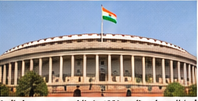
Editorial illustration — not an authenticated archival photograph. See the archival plate register for documented originals.
ARCHIVAL PLATE / COLLECTION RECORD • Constitution of India: National Archives of India (institutional record)
India’s republic promised a profound change: public authority would derive from a constitution and the electorate rather than dynastic descent. The Constitution took effect on 26 January 1950; formal recognition and privileges of former rulers were ended by constitutional amendment in 1971. I consider these changes among the most significant achievements of independent India.
Yet a legal transformation cannot by itself erase the social habits of centuries. Family names, palaces, old titles and inherited prestige still influence public imagination. I see this not as an argument against descendants of rulers, who enjoy the same rights as other citizens, but as a challenge to the electorate: are we judging representatives by their performance or by the grandeur surrounding them?
The marriages connecting Punjab political families and the former Dogra dynasty invite precisely this reflection. They are personal events, and I refuse to assign guilt through ancestry. But they reveal the durability of social networks that survived the end of princely sovereignty.
Chapter 2 — Ranjit Singh and the Making of the Lahore State
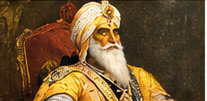
Editorial illustration — not an authenticated archival photograph. See the archival plate register for documented originals.
ARCHIVAL PLATE / COLLECTION RECORD • British Museum, object 1984,0124,0.1.1; Royal Collection RCIN 452414
Maharaja Ranjit Singh (1780–1839) emerged from the world of the Sikh misls and made Lahore the centre of an expanding state. The capture of Lahore in 1799, assumption of the title of Maharaja in 1801, and subsequent campaigns transformed a regional power into a kingdom of exceptional military and diplomatic consequence.
I admire his pragmatism. His court employed Sikh, Hindu and Muslim officials, alongside Europeans who assisted military modernization. The conquest of Multan in 1818 and Kashmir in 1819, followed by expansion toward Peshawar, enlarged the kingdom and its resources. Its strength was never merely a matter of cavalry or artillery; it depended on administration, negotiation and the capacity to manage competing elites.
The 1809 Treaty of Amritsar with the East India Company reflected his understanding that a strong neighbour could be contained through diplomacy as well as force. Yet the stability of the Lahore state remained closely tied to his personal command. I regard the weakness of succession arrangements as one of the great vulnerabilities of his achievement.
Chapter 3 — The Dogra Brothers: Service, Influence and Ambition
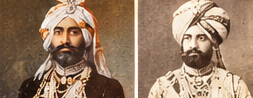
Editorial illustration — not an authenticated archival photograph. See the archival plate register for documented originals.
ARCHIVAL PLATE / COLLECTION RECORD • British Library Add Or 1390: Ranjit Singh with Dhian Singh, dated 1838–39
Gulab Singh, Dhian Singh and Suchet Singh rose to prominence in the service of the Lahore state. Dhian Singh became a central figure in court administration; Gulab Singh established a strong territorial base in Jammu and expanded Dogra power through campaigns led by officers such as Zorawar Singh.
The British Library preserves a drawing of Ranjit Singh seated with Dhian Singh standing before him (Add Or 1390). To me, this single contemporary object captures both the intimacy of court service and the later irony of political divergence. It does not prove betrayal, but it firmly places Dhian Singh within the Maharaja’s inner world.
I resist the temptation to portray an entire people or dynasty as uniformly treacherous. The Dogra brothers followed distinct trajectories, and the court contained many competing interests. Nevertheless, Gulab Singh’s emergence as a separate ruler after the Sikh defeat makes his ambitions and negotiations indispensable to the story.
Chapter 4 — 1839–1843: A Court in Crisis
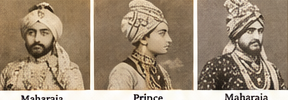
Editorial illustration — not an authenticated archival photograph. See the archival plate register for documented originals.
ARCHIVAL PLATE / COLLECTION RECORD • British Library Add Or 1389: Kharak Singh with Chet Singh
Ranjit Singh died in June 1839. His son Kharak Singh inherited the throne but was quickly weakened by factions at court. Nau Nihal Singh died in November 1840 after a gateway accident; the circumstances have generated competing interpretations, and I will not turn suspicion into certainty.
Chand Kaur’s brief political ascendancy, Sher Singh’s accession, and the assassinations of Sher Singh and Dhian Singh in September 1843 demonstrate how rapidly the state’s governing arrangements had broken down. The young Duleep Singh then became Maharaja, with his mother Jind Kaur at the centre of an increasingly precarious regency.
To me, the lesson is institutional. An empire built by one commanding personality had too few accepted procedures for transferring authority peacefully. British observers and officials increasingly saw an opening, but the succession crisis had already weakened the state from within.
Chapter 5 — Maharani Jind Kaur and the Child Sovereign
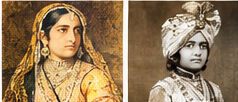
Editorial illustration — not an authenticated archival photograph. See the archival plate register for documented originals.
ARCHIVAL PLATE / COLLECTION RECORD • Royal Collection Trust, Duleep Singh collection story, RCIN 403843 and RCIN 2906556
Maharani Jind Kaur remains one of the most compelling figures of this period. As mother of the young Duleep Singh, she confronted an army with political influence, divided nobles and an expansionist East India Company. Her attempts to defend the position of her son deserve attention without reducing her to a romantic symbol.
After the first war, British intervention progressively restricted her authority. She was separated from Duleep Singh and eventually went into exile; mother and son were not reunited until 1861. The Royal Collection documents the prince’s later life in Britain, including an 1854 photograph by Ernst Becker and Winterhalter’s famous 1854 portrait.
When I look at that portrait, I see more than royal costume. I see a displaced child who became a celebrated guest in the country whose imperial expansion had ended his sovereignty. This is a personal response to a documented object, not a claim about what the artist intended.
Chapter 6 — The First Anglo-Sikh War
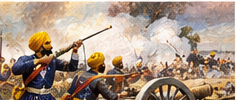
Editorial illustration — not an authenticated archival photograph. See the archival plate register for documented originals.
ARCHIVAL PLATE / COLLECTION RECORD • Period battle prints: consult British Library and British Museum catalogues
War broke out in December 1845 amid mutual military mobilization and severe instability in Lahore. The battles of Mudki, Ferozeshah, Aliwal and Sobraon brought heavy losses. The Khalsa soldiers fought with discipline and determination, and at moments British victory was far from assured.
Controversy surrounds the conduct of commanders Lal Singh and Tej Singh. Historians have examined communications with British officers and battlefield decisions that appear inconsistent with the interests of the Lahore state. Yet specific accusations must be distinguished from what surviving records establish; not every military setback can be explained by a single act of treachery.
I believe we honour the Khalsa Army best by taking both its courage and the complexities of command seriously. The defeat at Sobraon in February 1846 opened the route to Lahore and forced the state into negotiations from a position of weakness.
Chapter 7 — The Treaty of Lahore and the Treaty of Amritsar
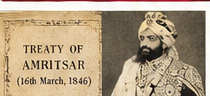
Editorial illustration — not an authenticated archival photograph. See the archival plate register for documented originals.
ARCHIVAL PLATE / COLLECTION RECORD • Treaty of Amritsar (16 March 1846); 1850 final payment receipt facsimile
The Treaty of Lahore in March 1846 imposed major territorial and financial obligations after the British victory. A second treaty, signed at Amritsar on 16 March, transferred specified mountainous territories, including Kashmir, to Gulab Singh and his heirs. Article III provided for payment of seventy-five lakh Nanakshahi rupees.
The surviving final receipt records that instalments were completed by March 1850. This distinction matters: the treaty dates from 1846, while the final documentary acknowledgment of full payment belongs to 1850. Popular accounts sometimes compress these events into the phrase “the sale of Kashmir.” I understand the moral force of that phrase, while recognizing that the legal instrument was a political transfer of sovereignty under imperial power.
What troubles me is the absence of consent from the populations whose political future was being decided. The British secured a strategic arrangement; Gulab Singh secured dynastic rule; the defeated Lahore state lost territory. The ordinary inhabitants did not negotiate the terms.
Chapter 8 — The Second War and Annexation
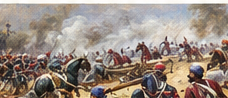
Editorial illustration — not an authenticated archival photograph. See the archival plate register for documented originals.
ARCHIVAL PLATE / COLLECTION RECORD • Archival prints of Chillianwala and Gujrat: institutional catalogues
The first war did not immediately abolish the Lahore monarchy. British supervision increased, and the uprising that began at Multan in 1848 broadened into the Second Anglo-Sikh War. At Chillianwala in January 1849, the British sustained severe losses; the battle remains evidence that Sikh resistance had not evaporated.
The British victory at Gujrat in February 1849 proved decisive. Punjab was annexed on 29 March 1849, and the young Duleep Singh was deprived of his sovereignty. The military conquest completed a political disintegration that had begun years earlier.
I see no historical value in attributing this enormous transformation to one family alone. Court factionalism, diplomacy, economic demands, military command and British imperial ambition all interacted. Historical judgment becomes more persuasive when it acknowledges several causes rather than seeking one villain.
Chapter 9 — Kashmir Under the Dogra Dynasty
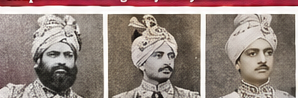
Editorial illustration — not an authenticated archival photograph. See the archival plate register for documented originals.
ARCHIVAL PLATE / COLLECTION RECORD • Dogra dynasty portrait collections: Jammu & Kashmir archives; image permissions to verify
Gulab Singh’s rule was followed by those of Ranbir Singh, Pratap Singh and Hari Singh. The princely state encompassed peoples, languages and landscapes of striking diversity. It developed administrative structures but also generated complaints over taxation, labour obligations and unequal political participation.
The histories of Jammu, the Kashmir Valley, Ladakh and adjoining regions cannot be reduced to the viewpoint of one court. I believe a fuller manuscript must consider the lives of subjects as well as rulers, and must not confuse dynastic continuity with popular legitimacy.
As the twentieth century progressed, demands for representative government grew. The end of British paramountcy in 1947 placed the state amid Partition, conflict and competing political claims.
Chapter 10 — The Last Maharaja and the New Indian Union
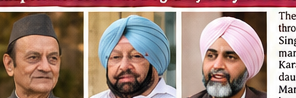
Editorial illustration — not an authenticated archival photograph. See the archival plate register for documented originals.
ARCHIVAL PLATE / COLLECTION RECORD • Archival portraits of Hari Singh and Karan Singh: source verification required
Maharaja Hari Singh signed the Instrument of Accession to India in October 1947 amid invasion and armed conflict. The constitutional and political consequences remain central to the modern history of Jammu and Kashmir and require careful treatment distinct from the events of 1846.
His son Dr. Karan Singh later served in major constitutional and political roles in independent India. I consider his career an example of how former princely families adapted to a republic, moving from hereditary office into public institutions.
The transition was not simply the disappearance of a title. It was a transformation in the source of legitimacy. The public could now question, elect and remove representatives; no ancestral claim should override those principles.
Chapter 11 — Patiala, Badal and the Modern Family Network
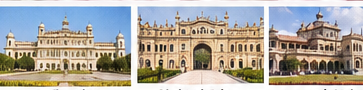
Editorial illustration — not an authenticated archival photograph. See the archival plate register for documented originals.
ARCHIVAL PLATE / COLLECTION RECORD • Contemporary event photographs: New Indian Express, 5 November 2026 (licensed reproduction not assumed)
In 2017, Nirvan Singh, grandson of Captain Amarinder Singh, married Mriganka Singh, granddaughter of Dr. Karan Singh. In November 2026, Rhea Badal, daughter of Manpreet Singh Badal, married R. K. Martand Singh, another grandchild of Dr. Karan Singh. Reporting from November 2026 describes gatherings of prominent political and former royal families.
These are real family connections, but I do not treat them as evidence of a hidden political agreement. People have every right to marry across party and historical boundaries. A wedding is not a confession of allegiance to an ancestor’s decisions.
What interests me is the persistence of elite networks. Families associated with the old princely order remain socially connected to families influential in electoral politics. In a republic, the relevant question is not whom they marry, but whether their access to public power is subject to the same scrutiny as everyone else’s.
Chapter 12 — The Political Worker and the Political Elite
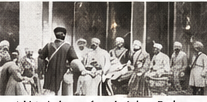
Editorial illustration — not an authenticated archival photograph. See the archival plate register for documented originals.
ARCHIVAL PLATE / COLLECTION RECORD • Modern rural political photographs require separate photographer permission
I have seen how political competition can become intensely personal. In villages, party rivalries may strain friendships, divide relatives and turn local disputes into lasting bitterness. The costs are borne by ordinary people, not merely by those who seek office.
At the same time, leaders from opposing parties may remain personally cordial, attend family celebrations and maintain friendships. I welcome civility among opponents; democracy would be poorer without it. But I question why supporters sometimes behave as though political disagreement requires social enmity.
I prefer to evaluate an issue rather than pledge automatic loyalty to a party. Good policy deserves recognition whoever proposes it; wrongdoing deserves criticism whoever commits it. That is the citizenship I wish to encourage.
Chapter 13 — Memory, Evidence and Hereditary Responsibility
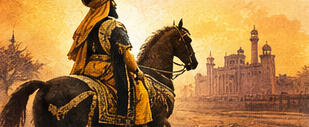
Editorial illustration — not an authenticated archival photograph. See the archival plate register for documented originals.
ARCHIVAL PLATE / COLLECTION RECORD • Archival juxtaposition: British Library Add Or 1390 and 1850 treaty receipt
Punjab’s past deserves remembrance, but remembrance must be disciplined. A period portrait confirms that a figure was represented in a particular context; it cannot by itself establish motives. A treaty proves its terms; it does not settle every moral argument about the circumstances in which it was signed.
I therefore distinguish documented action from later accusation, and political responsibility from inherited identity. Gulab Singh’s negotiations can be scrutinized; the decisions of nineteenth-century commanders can be debated. But their descendants cannot be presumed guilty by bloodline.
In my view, history should make us more demanding of evidence and more humane in judgment. The two obligations reinforce each other.
Chapter 14 — Democracy Beyond the Royal Mindset
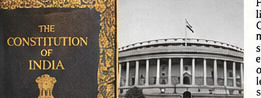
Editorial illustration — not an authenticated archival photograph. See the archival plate register for documented originals.
ARCHIVAL PLATE / COLLECTION RECORD • Constitution of India, original manuscript; official archival reference
The end of princely rule did not automatically end the temptation to admire hereditary power. The royal mindset survives whenever a surname counts for more than service, a title for more than competence, or loyalty to a family for more than loyalty to law.
I do not oppose former royal descendants entering politics. I oppose the notion that any citizen is born entitled to govern. Public office should depend on elections, transparent institutions, administrative performance and accountability.
The greatest lesson I draw from the fall of the Sikh Empire is that institutions matter more than personalities. We honour Ranjit Singh not by treating modern politicians as kings, but by asking whether they build institutions strong enough to survive them.
Epilogue — My Appeal to the Reader
I want Punjab to remember its past without becoming imprisoned by it. I want citizens to respect their neighbours across political differences, to demand honesty from leaders, and to measure every government by what it does for education, agriculture, employment, public safety and the rule of law. Thrones are gone; citizenship must now be our guiding principle.
— PreetMohan Singh Kapoor
Selected Chronology
1799 — Ranjit Singh takes Lahore
1801 — Assumes title of Maharaja
1809 — Treaty with East India Company
1818–1819 — Multan and Kashmir conquered
1839 — Death of Ranjit Singh
1843 — Duleep Singh becomes Maharaja
1845–1846 — First Anglo-Sikh War
16 March 1846 — Treaty of Amritsar
1848–1849 — Second Anglo-Sikh War
29 March 1849 — British annexation of Punjab
14 March 1850 — Final treaty instalment recorded as paid
1947 — Hari Singh signs Instrument of Accession
1971 — Privy purses and recognition abolished
2017 — Nirvan Singh–Mriganka Singh marriage
2026 — Rhea Badal–Martand Singh marriage
Authenticated Archival Plate Register
Editorial note: Chapter images are editorial illustrations, NOT authenticated archival reproductions. The following records identify genuine historic artworks and documents for further research. Do not attribute the chapter illustrations to these collections.
Plate A: Maharaja Ranjit Singh, nineteenth-century watercolour
Collection: British Museum, 1984,0124,0.1.1
Catalogue: https://www.britishmuseum.org/collection/object/A_1984-0124-0-1-1
Plate B: Ranjit Singh with Dhian Singh, 1838–39
Collection: British Library, Add Or 1390
Catalogue: https://searcharchives.bl.uk/catalog/040-003271245
Plate C: Maharaja Duleep Singh, 1854, Franz Xaver Winterhalter
Collection: Royal Collection Trust, RCIN 403843
Catalogue: https://www.rct.uk/collection/stories/maharaja-duleep-singh
Plate D: Duleep Singh photograph by Ernst Becker, 1854
Collection: Royal Collection Trust, RCIN 2906556
Catalogue: https://www.rct.uk/collection/stories/maharaja-duleep-singh
Plate E: Facsimile of Kashmir transfer payment receipt
Collection: Wikimedia Commons; original source and 1850 dating discussed in record
Catalogue: https://commons.wikimedia.org/wiki/File:Original_receipt_of_the_transfer_of_Kashmir_by_Lord_Hardinge_to_Gulab_Singh,_1846.jpg
Plate F: Court painting of Ranjit Singh, ca. 1850
Collection: Wikimedia Commons collection entry; later painting, not an eyewitness photograph
Catalogue: https://commons.wikimedia.org/wiki/File:Painting_of_the_Darbar_(royal_court)_of_Maharaja_Ranjit_Singh,_ca.1850.jpg
Documentary Sources and Further Reading
Royal Collection Trust, “Maharaja Duleep Singh”: https://www.rct.uk/collection/stories/maharaja-duleep-singh
British Library, Add Or 1390: https://searcharchives.bl.uk/catalog/040-003271245
British Museum, portrait of Ranjit Singh: https://www.britishmuseum.org/collection/object/A_1984-0124-0-1-1
Treaty of Amritsar and final receipt facsimile: https://uploads-ssl.webflow.com/6031a13f23a42e1120a8c37c/60b418625ece85bb13d7c3cd_Treaty%20of%20Amritsar%20with%20context%20and%20receipt.pdf
The New Indian Express, 5 November 2026, reporting on Badal–Dogra marriage: https://www.newindianexpress.com/india/2026/Nov/05/manpreet-badal-and-karan-singhs-families-unite-in-new-delhi-for-wedding-strengthens-royalty-politics-ties
J. S. Grewal, The Sikhs of the Punjab (historical overview)
Khushwant Singh, A History of the Sikhs, Volume 1 (secondary history; compare interpretations)
C. A. Bayly, Indian Society and the Making of the British Empire (imperial context)
IMAGE RIGHTS AND RESEARCH NOTE
The 14 chapter illustrations in this edition are AI-generated editorial artwork, not original archival photographs. Historical collection references in the archival register are research leads only; no archival image licensing or permissions are represented as secured. Confirm all historical claims, quotations, and modern biographical details against primary sources before commercial publication. Disclose AI-generated content in the KDP publishing workflow.
THE ROYAL MINDSET • PREETMOHAN SINGH KAPOOR


No comments:
Post a Comment